An SOP is only worth writing if people use it. Most are not used, and the reasons are consistent: the wrong format for the shape of the process, no version number so nobody knows which copy is current, written by someone who does not do the job, or a description of how the work is supposed to happen rather than how it actually does.
The templates below are free to download in Word. Before them is how to pick the right format, because that decision determines which template you need.
Which SOP Format Do You Need?
Four formats, and the right one follows the shape of the process rather than personal preference.
| Format | Use when | Looks like |
|---|---|---|
| Simple steps | Short, routine, low-risk task with no branching | A numbered list on one page |
| Hierarchical steps | Longer procedure where some users need detail and others do not | Numbered steps with indented sub-steps |
| Flowchart | The process has decision points — if this, then that | Boxes and branches |
| Checklist | Verifying that things were done, not instructing how | Tick boxes with initials and a time |
The one that matters is the third. A branching process written as a numbered list produces errors, because the reader has to hold the conditions in their head while following a sequence that does not acknowledge them. If your procedure contains more than one or two “if”, draw it.
And a checklist is not a short SOP. A checklist assumes the reader already knows how; it exists to confirm nothing was skipped. Opening and closing routines, pre-start safety checks and handovers want checklists. Teaching someone the task wants steps.
Free SOP Templates
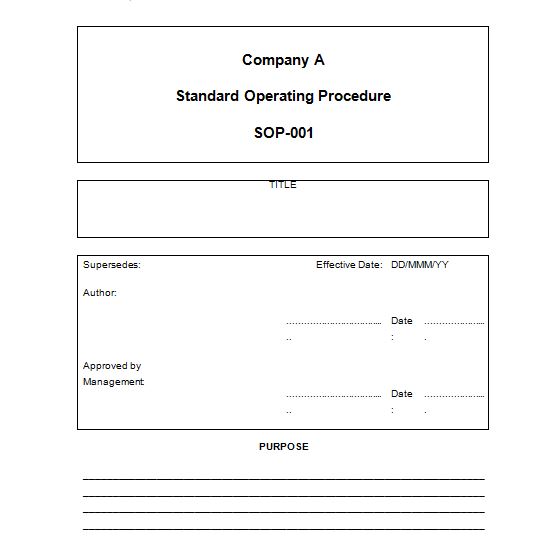
SOP Templates (Set 1)




SOP Templates (Set 2)


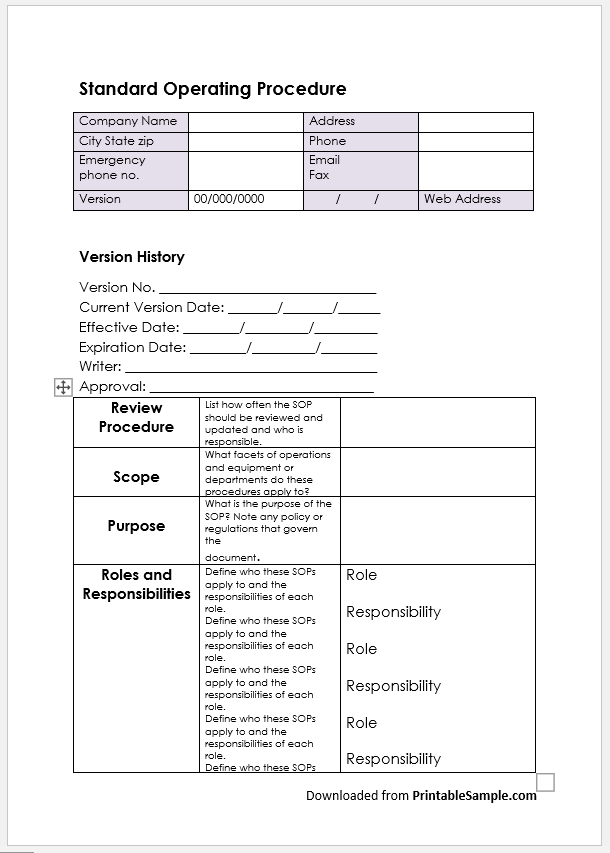

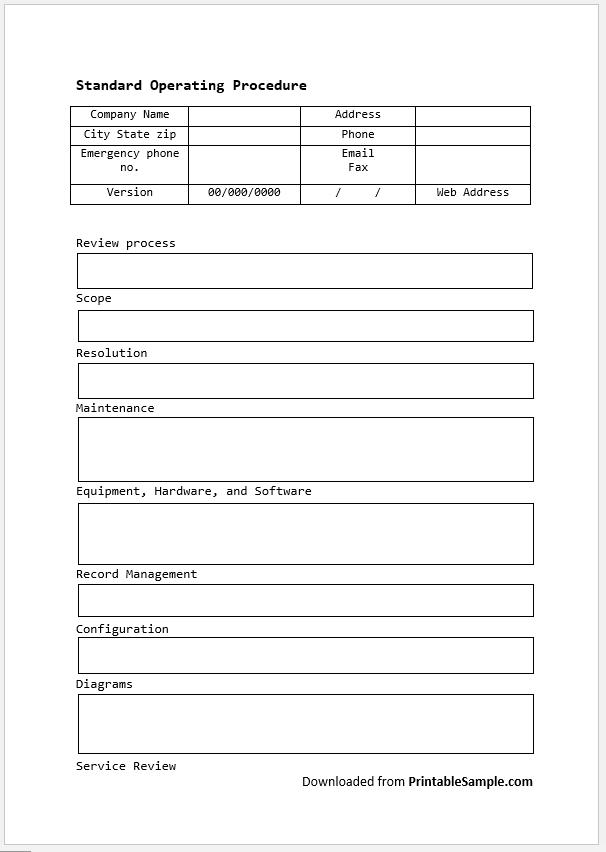


Templates are being reorganised by format. See the four categories above to choose the right type for your process.
SOP, Work Instruction, or Policy?
These four sit in a hierarchy, and conflating them is why some organisations have forty-page SOPs that are really policies and one-line SOPs that are really work instructions.
| Document | Answers | Example |
|---|---|---|
| Policy | What the rule is, and why | All refunds above a set amount require manager approval |
| Process | The end-to-end sequence across roles | How an order travels from enquiry to delivery |
| Procedure (SOP) | How one task is performed, by whom, in what order | How to process a refund in the system |
| Work instruction | The detail of a single step | Which screen and which field to enter the refund code in |
A useful test: if it has no steps, it is a policy. If the steps cross several departments, it is a process. If it describes which button to press, it is a work instruction. An SOP sits between the last two.
The Document Control Header
This is the part most free templates omit and the part that decides whether an SOP is usable at all.
Every SOP needs a header block carrying:
- Document ID — a unique reference
- Title
- Version number
- Effective date — when this version takes effect, which is not the same as the date it was written
- Review date — when it must next be looked at
- Owner — the named person responsible for keeping it current
- Approved by — who signed it off, and when
- Supersedes — which version this replaces
- Page x of y on every page
Without a version number and an effective date, two copies of an SOP cannot be told apart, and in practice both stay in circulation. That alone is enough to make a procedure unreliable, and in a regulated environment it is a finding at audit.
“Page x of y” sounds trivial until a page goes missing from a printed copy and nobody notices.
Numbering
Keep the scheme simple: a short department or function code plus a sequence number, such as QA-014 or WH-003. Add the version separately rather than inside the ID.
Resist encoding too much meaning. A number that carries site, department, function, process and risk level breaks the first time the organisation reorganises, and then you have either wrong numbers or a renumbering exercise nobody wants. Never reuse a retired number either — an obsolete SOP should still be findable by its original reference.
Writing an SOP People Can Follow
Use the imperative and the second person. “Record the batch number” — not “the batch number should be recorded”, which leaves the reader unsure whether it is their job.
One action per step. If a step contains “and”, it is probably two steps. A reader interrupted halfway through a compound step cannot tell what they completed.
Say who does it wherever more than one role is involved, at the start of the step rather than the end.
Put warnings before the step, not after. A caution printed beneath the instruction is read after the thing it was meant to prevent.
Cut the hedging. “As appropriate”, “if necessary”, “where required” and “ensure that” all push a decision back onto the reader without telling them how to make it. If a judgement is genuinely required, state the criteria.
Use the words the operators use. If everyone on the floor calls it the big press, write the big press and put the asset number in brackets. An SOP in management vocabulary gets translated in people’s heads, and translation is where errors enter.
Define acronyms once, at the top. Then use them.
Keep it as short as the task allows. A ten-minute job described over fifteen pages will not be read, and an unread SOP is worse than none because it creates a false record of control.
Why SOPs Stop Being Used
In rough order of how often each is the real cause.
It describes the ideal process, not the actual one. This is the most damaging and the least discussed. If the written procedure differs from what people genuinely do, they follow the real method and the document becomes decoration — and once staff learn that SOPs describe fiction, they stop reading all of them. Either fix the process or document what actually happens, including the workaround, and then decide whether the workaround should be designed out.
It was written by someone who does not do the job. The person who performs the task daily knows the steps that are missing, the order that actually works, and the two things that go wrong. Draft with them, not about them.
It is not where the work happens. A procedure in a binder in an office, or a PDF on a shared drive, is not available at a machine or a counter. Print the ones used at a station, laminate them, and put them at the station.
It was never reviewed. An SOP referring to equipment replaced three years ago teaches everyone to distrust the whole set.
Nobody owns it. A document with no named owner is a document nobody updates.
Training and Sign-Off
An SOP is not finished when it is approved. It is finished when the people who do the work have read it and recorded that they have.
Keep a training record showing person, SOP, version and date. Re-sign on any material revision — not on a typo correction, but on anything that changes what someone does. In regulated sectors this is a requirement; everywhere else it is the only evidence that an instruction was actually communicated.
Where the procedure is new or significantly changed, walk through it with the people doing it rather than emailing the document. The walkthrough also catches the step you got wrong, which is cheaper to find now.
See training attendance sheets for recording the session and training certificates where competence needs to be evidenced.
Review and Revision
Set a review date on every SOP — annually or every two years for most, more often where risk is high — and review on event as well as on schedule:
- New or changed equipment, software or materials
- A regulatory or standard change
- After an incident, a near miss, or a recurring defect
- After a customer complaint traced to the procedure
- When the people doing the work say the document is wrong
That last trigger is the most valuable and the most often ignored. Make it easy to report — a line on the SOP saying who to tell and how.
When an incident investigation identifies a procedural cause, the corrective action should be a specific SOP revision with a version number, not “remind staff of the procedure”. See root cause analysis templates for working the cause through properly.
Keep superseded versions. You will need to show what the procedure said at the time of a past event, and a system that overwrites the previous version cannot answer that.
A Note on ISO 9001
A common misconception is that ISO 9001 requires an SOP for every process. It does not.
Since the 2015 revision the standard refers to “documented information” and leaves it to the organisation to determine what documented information is necessary for the effectiveness of its system. It no longer mandates a quality manual or a fixed list of documented procedures.
So the question is not “does ISO want an SOP for this” but “would this task go wrong without one”. Writing procedures to satisfy an auditor rather than an operator is how organisations end up with shelves of documents nobody follows.
Regulated sectors are different. In pharmaceutical, food, medical device and aviation environments, SOPs are controlled documents with formal approval, controlled distribution, trained-and-signed records and defined retention. If you work under a quality system of that kind, check any template against your own document control procedure before adopting it.
Related Templates
- Root cause analysis templates — for incidents that lead to an SOP revision
- Training attendance sheets — for recording SOP training
- Training certificates
- Training feedback forms
- Inventory lists — for laboratory and warehouse procedures
- Schedule templates
- Bid evaluation forms
- Meeting attendance sheets
- All printable forms
Frequently Asked Questions
What is a standard operating procedure?
A document setting out how a specific task is performed — by whom, in what order, and to what standard — so that it is done the same way each time regardless of who does it.
Which SOP format should I use?
Simple numbered steps for a short routine task, hierarchical steps where some users need more detail than others, a flowchart where the process has decision points, and a checklist where the purpose is confirming things were done rather than teaching how. The format follows the shape of the process.
When should an SOP be a flowchart rather than a list?
As soon as it contains more than one or two decision points. A branching process written as a numbered list produces errors, because the reader has to hold the conditions in their head while following a sequence that does not acknowledge them.
Is a checklist the same as a short SOP?
No. A checklist assumes the reader already knows how and exists to confirm nothing was skipped. An SOP teaches the task. Opening routines, pre-start safety checks and handovers want checklists; training someone wants steps.
What is the difference between an SOP and a work instruction?
An SOP describes how a task is performed from start to finish. A work instruction covers the detail of a single step, often at the level of which screen or which control. A policy states the rule and why; a process describes the end-to-end sequence across departments.
What should the SOP header contain?
Document ID, title, version number, effective date, review date, named owner, who approved it and when, which version it supersedes, and “page x of y” on every page. Without a version number and an effective date, two copies cannot be told apart.
How should SOPs be numbered?
A short department or function code plus a sequence number, such as QA-014, with the version recorded separately. Avoid encoding site, function and risk level into the number, because it breaks at the first reorganisation. Never reuse a retired number.
How should an SOP be written?
In the imperative and second person, one action per step, naming who performs the step where several roles are involved. Put warnings before the step they relate to, cut hedging phrases such as “as appropriate”, and use the words the people doing the work actually use.
Why do SOPs stop being used?
Most often because the document describes the ideal process rather than the real one, so people follow the real method and learn to distrust SOPs generally. Then: written by someone who does not do the job, not available where the work happens, never reviewed, and nobody named as owner.
Do staff need to sign for SOP training?
Keep a record of person, SOP, version and date, and re-sign on any revision that changes what someone does. In regulated sectors it is required; elsewhere it is the only evidence an instruction was actually communicated.
How often should SOPs be reviewed?
Annually or every two years for most, more often where risk is high — and on event as well: new equipment or software, a regulatory change, after an incident or near miss, after a complaint traced to the procedure, and whenever the people doing the work say it is wrong.
Does ISO 9001 require an SOP for every process?
No. Since the 2015 revision the standard refers to “documented information” and leaves the organisation to determine what is necessary, with no mandated quality manual or fixed list of procedures. The question is whether a task would go wrong without one, not whether an auditor expects one.
Are these SOP templates free?
Yes. Every template on this page can be downloaded, edited and printed free, including for commercial use. If you work under a formal quality system, check any template against your own document control procedure first.
