A sales representative agreement sets out how someone sells on your behalf and what they get paid for it. The clauses that matter are commission — when it is earned, how it is calculated, and whether it survives termination — and almost every dispute in this area comes back to one of those three.
Below you will find free sales representative agreement templates in Word, covering employed reps, independent contractors and commercial agents, along with the commission structures and territory arrangements each one needs.
These templates are drafting aids, not finished contracts. How a sales representative is classified has tax and employment consequences, and commercial agents hold statutory protections in several countries that cannot be contracted away. Have a qualified lawyer review the document before either party signs.
What Is a Sales Representative Agreement?
A sales representative agreement is a contract between a company and a person or firm who sells its products or services. It defines what they may sell, to whom, on what terms, and how they are paid.
The representative does not usually buy the goods. They introduce or close sales on the company’s behalf and are paid a commission on what they bring in. That distinguishes the arrangement from a reseller agreement, where the other party buys stock and resells it at its own margin and risk.
Employee, Independent Contractor or Commercial Agent?
This is the first decision and the one with the largest consequences if you get it wrong.
| Employed sales rep | Independent contractor | Commercial agent | |
|---|---|---|---|
| Relationship | Employment contract | Services contract | Agency relationship |
| Control | Company directs how the work is done | Rep decides their own methods | Rep acts on the company’s behalf with authority to negotiate |
| Pay | Salary plus commission; payroll taxes apply | Commission or fees; invoices the company | Commission on sales concluded |
| Rights on termination | Employment protections, notice, severance | Whatever the contract says | Statutory compensation in many jurisdictions |
| Expenses and tools | Usually provided by the company | Usually the rep’s own | Usually the rep’s own |
Labelling someone an independent contractor does not make them one. Tax authorities and employment tribunals look at the substance — who controls the work, who bears the financial risk, whether the person can send a substitute, whether they work exclusively for one company. Misclassification typically results in back taxes, penalties and retrospective employment rights.
Commission Structures
| Structure | How it works | Suits |
|---|---|---|
| Commission only | Paid solely on sales closed | Established reps with their own network; high-margin products |
| Base plus commission | A salary or retainer, with commission on top | Long sales cycles where a rep cannot survive on commission alone |
| Draw against commission | An advance each period, recovered from future commission | New reps building a pipeline; specify whether the draw is recoverable |
| Tiered commission | The rate rises once targets are passed | Driving performance beyond a baseline |
| Flat fee per sale | A fixed amount per unit or contract | Standardised products with consistent pricing |
When Is Commission Earned?
This single question causes more sales commission disputes than everything else combined. The agreement must say which event earns the commission:
- When the order is placed
- When the goods ship or the service is delivered
- When the customer pays
- When the payment clears and the return period has expired
Each is defensible and they produce very different outcomes. Also state what happens on a refund, a cancellation, a bad debt, or a partial payment — whether commission is clawed back, and within what period.
What the Agreement Should Cover
| Clause | What it settles |
|---|---|
| Parties and classification | Who the parties are and whether the rep is an employee, contractor or agent |
| Products and services | Exactly what the rep is authorised to sell |
| Territory | Geographic area, named accounts, or market sector |
| Exclusivity | Whether the rep is the only one in that territory, and whether the company may sell direct |
| Authority | Whether the rep may negotiate price, sign contracts or only introduce leads |
| Commission rate and basis | The percentage or fee, and whether it is on gross, net or margin |
| When commission is earned | The triggering event, and treatment of refunds and cancellations |
| Payment timing | When commission is paid and what statement accompanies it |
| Targets and quotas | Minimum performance, and the consequence of missing it |
| Expenses | What the company reimburses and what the rep bears |
| Term and termination | Notice periods and grounds for immediate termination |
| Post-termination commission | Whether the rep is paid on sales concluded after they leave |
| Confidentiality and non-solicitation | Protection for customer lists and pricing after departure |
| Governing law | Which law applies, and whether agency protections are engaged |
Free Sales Representative Agreement Templates
Each preview below links to a downloadable file. Start with the one that matches how the rep will be engaged — employed, independent, or as an agent.

Independent Sales Representative Agreement
For a self-employed rep working on commission, with territory and authority clauses. The most commonly needed version.
File Type: MS Word (ZIP File)
Source: fx365i.com

Sales Representative Employment Agreement
For an employed rep on salary plus commission, including notice periods and employment terms.
File Type: MS Word (ZIP File)
Source: labusinessconnect.com

Sales Agency Agreement
An agency arrangement where the rep acts on the company’s behalf, with authority and commission entitlement defined.
File Type: MS Word (ZIP File)
Source: ucalgary.ca

Sales Agency Agreement (UK Format)
Drafted for UK and Irish use, where commercial agents hold statutory rights on termination.
File Type: MS Word (ZIP File)
Source: venturehothouse.co.uk
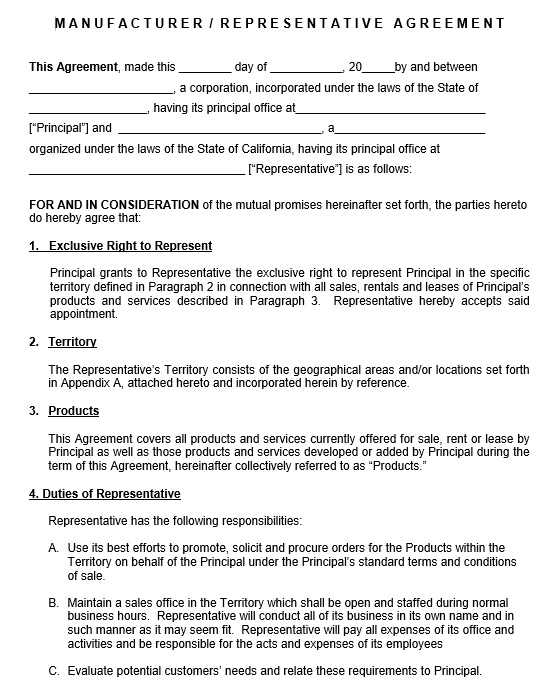
Sales Representative Contract
A plainly worded contract covering duties, commission and termination, with no jurisdiction-specific terms.
File Type: MS Word (ZIP File)
Source: erascal.org

Sales Rep Agreement Precedent
A longer precedent with more detailed drafting, useful as a reference for clauses the shorter templates omit.
File Type: MS Word (ZIP File)
Source: lawyercorporation.ca

Inside Sales Rep Compensation Plan
Not an agreement but a companion document — sets out quota, commission rates and accelerators for an inside sales role.
File Type: MS Word (ZIP File)
Source: qcommission.com
Territory, Exclusivity and House Accounts
Territory can be defined geographically, by named accounts, or by market sector. Say which, and define it precisely — “the northern region” means different things to different people.
Exclusivity determines whether the company may appoint another rep in the same territory, and whether it may sell there directly. An exclusive rep usually expects commission on every sale in their territory, including ones they had no part in. Decide that explicitly.
House accounts are customers the company serves directly, with no commission payable. Listing them in a schedule at the outset prevents the argument that follows when a rep discovers a major account in their territory was excluded.
Split commissions arise when two reps touch the same deal, or a customer in one territory orders for delivery in another. Set the rule in advance rather than deciding case by case.
Termination and Post-Termination Commission
A rep who builds a pipeline over two years and is terminated the month before several large deals close will argue they earned those commissions. The agreement should answer that before it happens.
Common approaches are a tail period — commission on sales closing within a stated number of months after termination — or payment on deals that were already at a defined stage in the pipeline.
Be aware that in several jurisdictions this is not purely a matter of contract. Many US states have sales representative statutes requiring prompt payment of earned commissions, with penalties for late payment, and courts in some apply a “procuring cause” principle entitling a rep to commission on sales they brought about even after the relationship ends.
Commercial Agents Have Statutory Rights
In the United Kingdom and Ireland, and across the EU, commercial agents selling goods are protected by regulations that give them compensation or an indemnity when the agency ends — including where it ends by expiry rather than breach. These rights cannot be excluded by the contract.
In the United Arab Emirates, a registered commercial agency gives the agent exclusivity in its territory and makes termination very difficult without compensation. Registration matters enormously, and appointing a UAE agent without understanding the consequences is a well-known trap for foreign companies.
India has no equivalent commercial agency statute; the arrangement is governed by the general law of contract and agency, which makes the drafting of the agreement correspondingly more important.
Common Mistakes to Avoid
The most common mistake is not stating when commission is earned. “Commission of 10% on sales” does not say whether that means orders taken, goods shipped, or cash received.
The second is misclassifying the rep. Calling an employee a contractor to avoid payroll taxes is the single most expensive error on this page.
The third is silence on post-termination commission. The absence of a clause does not mean nothing is owed — in some jurisdictions it means a court decides.
The fourth is no house account schedule in an exclusive territory. Attach the list at signature.
Finally, do not appoint an overseas agent without checking local agency law. In the Gulf and the EU, statutory protections may make the relationship far harder to exit than the contract suggests.
Related Sales and Agreement Templates
- Reseller agreements — where the other party buys and resells rather than earning commission
- Independent contractor agreements — the general form for self-employed engagements
- Sales contracts — for the transactions the rep brings in
- Non-disclosure agreements — to protect customer lists and pricing
- Private label agreements
- Sales logs — for tracking what each rep has sold
- Sales proposals — for the pitch itself
- Sales invoices — for billing the resulting orders
- Employment certificates — for confirming a rep’s service history
- All agreement templates — the complete collection
Frequently Asked Questions
What is a sales representative agreement?
A sales representative agreement is a contract between a company and a person or firm who sells its products on its behalf. It covers what they may sell, in which territory, the commission they earn, and what happens when the arrangement ends.
What is the difference between a sales representative and a reseller?
A sales representative sells on the company’s behalf and earns commission; they never own the goods. A reseller buys the goods and resells them at its own margin, carrying the stock and the risk.
When is sales commission earned?
Only when the agreement says so. The usual options are on order, on shipment, on payment received, or once the return period has expired. State one explicitly, together with what happens on refunds and cancellations.
What commission structures are common?
Commission only, base plus commission, draw against commission, tiered rates that rise after a target, and a flat fee per sale. Which fits depends on the sales cycle and whether the rep can realistically live on commission alone.
Is a sales rep an employee or an independent contractor?
It depends on the substance of the relationship, not the label in the contract. Control over how the work is done, financial risk, exclusivity and the right to send a substitute all count. Misclassification can mean back taxes and retrospective employment rights.
Is commission payable after a sales rep leaves?
It depends on the agreement and the jurisdiction. Many contracts provide a tail period covering deals that close within a stated number of months. Some US states and several other legal systems apply a procuring-cause principle regardless of what the contract says.
What is a house account?
A customer the company serves directly, on which no commission is payable. House accounts should be listed in a schedule when the agreement is signed, not identified after a rep makes a claim.
Do commercial agents have special legal rights?
In the UK, Ireland and across the EU, commercial agents selling goods are entitled to compensation or an indemnity when the agency ends, and these rights cannot be contracted out of. In the UAE, a registered commercial agency gives strong territorial exclusivity and makes termination difficult.
What should an exclusive territory clause include?
A precise definition of the area or accounts, whether the company may sell direct within it, whether commission is payable on sales the rep did not make, and any performance targets on which exclusivity depends.
Are these sales representative agreement templates free?
Yes. Every template on this page can be downloaded and adapted free. They are provided as examples of document structure, not as legal advice.

Pingback: Independent Contractor Agreement Template - Free Word