A loan agreement records how much was lent, on what terms it must be repaid, and what happens if it is not. Without one, a loan is a conversation — and conversations are hard to enforce.
Below you will find free loan agreement templates in Word covering simple personal loans, consumer loans, interest-free loans, intercompany loans and convertible loans, along with the clauses each one needs.
These templates are drafting aids, not finished contracts. Lending is regulated differently in every country, interest rates are capped in many, and lending as a business usually requires a licence. Have a qualified lawyer review the document before either party signs.
What Is a Loan Agreement?
A loan agreement is a contract between a lender and a borrower setting out the amount advanced, the interest, the repayment schedule, and the consequences of missing payments. Both parties sign it, and it binds both — the lender to advance the funds, the borrower to repay them.
It differs from an informal arrangement in one practical way: it is evidence. If repayment is disputed, a signed agreement showing the amount, the date and the schedule is what a court will look at. A verbal promise and a bank transfer are much harder to enforce.
Types of Loan Agreement
| Type | What it is | What it needs beyond the basics |
|---|---|---|
| Personal or private loan | Between individuals — family, friends, colleagues | Clear repayment schedule and a statement of whether interest applies |
| Consumer loan | A business lending to an individual | Regulated in most countries: disclosure of total cost, cooling-off rights, licensing |
| Business or commercial loan | Lending to a company | Covenants, financial reporting, director or parent guarantee |
| Term loan | A fixed sum repaid on a set schedule | Amortisation table, maturity date, prepayment terms |
| Demand loan | Repayable whenever the lender asks | Notice period before repayment falls due |
| Intercompany loan | Between companies in the same group | Arm’s length interest rate, transfer pricing and tax treatment |
| Convertible loan | Converts to equity instead of being repaid | Conversion trigger, valuation cap, discount, what happens if no round occurs |
| Interest-free loan | Only the principal is repayable | Explicit statement that no interest accrues; tax treatment may still apply |
| Secured loan | Backed by an asset the lender can claim | Description of the collateral and how it is enforced — often a separate security agreement |
What a Loan Agreement Must Include
| Clause | What it settles |
|---|---|
| Parties | Full legal names, addresses and identification of lender and borrower |
| Principal amount | The sum lent, written in figures and in words |
| Date of advance | When the money is actually transferred, and by what method |
| Interest rate | The rate, whether it is simple or compound, and the period it is calculated over |
| Repayment schedule | Instalment amount, frequency, first payment date and number of payments |
| Maturity date | When the final payment is due and the loan closes |
| Prepayment | Whether early repayment is allowed, and whether a fee applies |
| Late payment | Default interest or a late fee, and when it starts to run |
| Security or collateral | Any asset pledged, and the lender’s rights over it |
| Guarantor | Any third party who agrees to pay if the borrower does not |
| Events of default | What counts as default, and whether the whole balance becomes due |
| Governing law | Which law applies and where disputes are heard |
| Signatures and witnesses | Who signs, and whether witnessing, stamping or notarisation is required locally |
Writing the principal in both figures and words is not a formality. Where the two conflict, many legal systems give the written words precedence, and it is the single cheapest protection against an altered document.
Free Loan Agreement Templates
Each preview below links to a downloadable file. Start with the type that matches your arrangement rather than the first template on the page.

Simple Loan Agreement
A short agreement for a straightforward loan between two parties. The best starting point for a private loan.
File Type: MS Word (ZIP File)

Loan Agreement Template (Word)
A fuller clause set covering interest, default and security, editable directly in Word.
File Type: MS Word (ZIP File)

Consumer Loan Agreement
For a business lending to an individual, with disclosure of the total cost of credit. Consumer lending is regulated — check your licensing position.
File Type: MS Word (ZIP File)

Interest-Free Loan Agreement
Only the principal is repayable. Suits family lending and arrangements that must avoid interest.
File Type: MS Word (ZIP File)

Convertible Loan Agreement
For startup financing where the loan converts to equity. Covers the conversion trigger, valuation cap and discount.
File Type: MS Word (ZIP File)

Intercompany Term Loan Agreement
For lending between companies in the same group, with a fixed term and scheduled repayments.
File Type: MS Word (ZIP File)
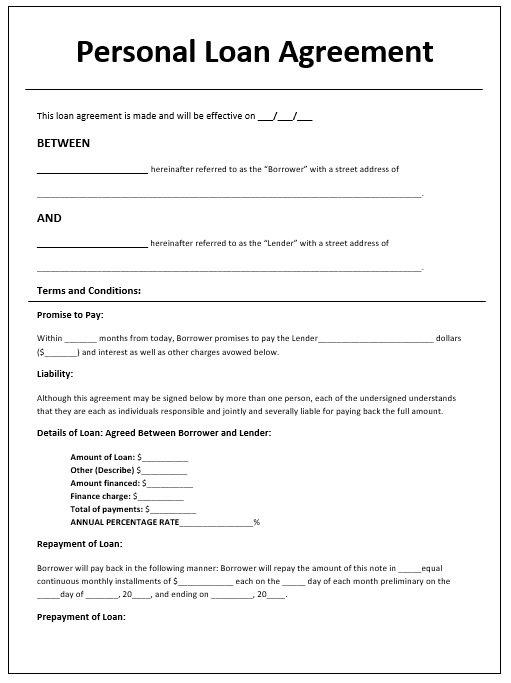
Standard Loan Agreement
Principal, interest and events of default set out in a conventional clause order.
File Type: MS Word (ZIP File)
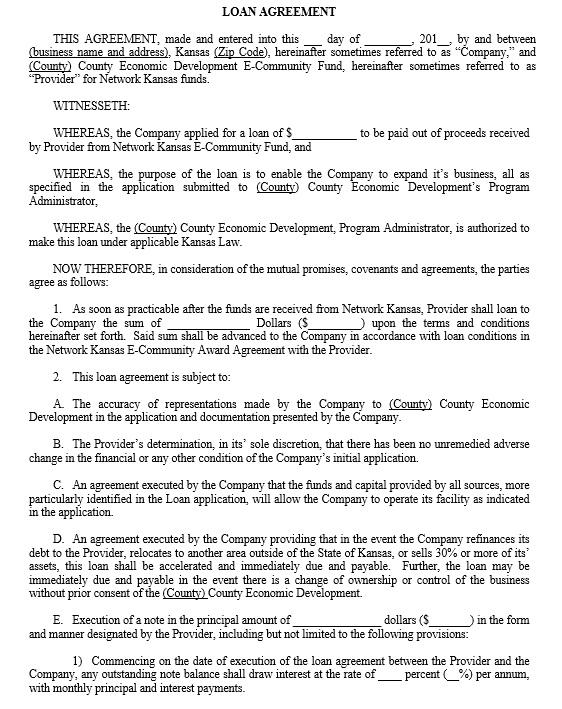
Sample Loan Agreement
A worked example with the clauses completed, useful for seeing how the terms read in a finished document.
File Type: MS Word (ZIP File)
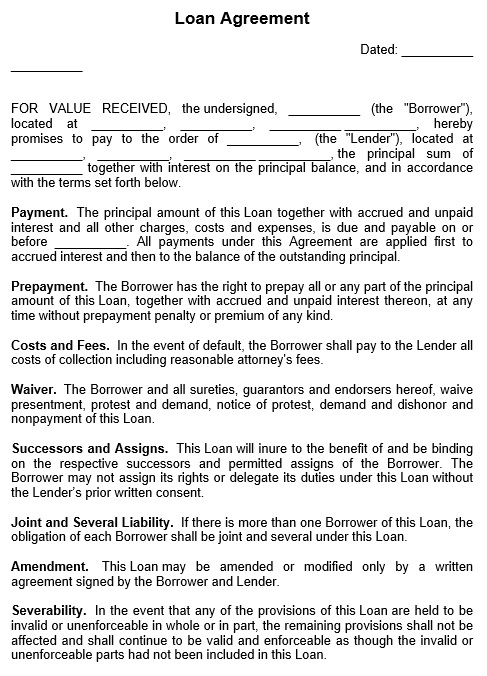
Loan Agreement (Alternative Format)
A different clause arrangement, worth comparing against the standard version before you settle on one.
File Type: MS Word (ZIP File)
Loan Agreement, Promissory Note or IOU?
| Document | Who signs | What it contains | Strength |
|---|---|---|---|
| IOU | Borrower | Acknowledges a debt exists; often just an amount and a date | Weakest — proves debt, rarely proves terms |
| Promissory note | Borrower | A one-sided promise to pay, with amount, interest and schedule | Strong on repayment, silent on the lender’s obligations |
| Loan agreement | Both parties | Full contract: advance, interest, covenants, security, default | Strongest — binds both sides |
For a small loan between people who trust each other, a promissory note is usually enough. For anything involving security, a guarantor, covenants or a business borrower, use the full agreement.
Interest, Security and Default
Interest and Legal Limits
State the rate, whether it is calculated as simple or compound interest, and the period it applies to. “10% interest” without saying per year or per month is ambiguous and has caused a great many disputes.
Most countries cap what can be charged. Lending at excessive rates may be unenforceable or a criminal offence depending on where you are, and lending to consumers as a business almost always requires a licence. Check the position in your jurisdiction before setting a rate.
Interest-Free and Islamic Finance Arrangements
Interest-free lending is not only a family arrangement. In Islamic finance, charging interest — riba — is prohibited, and a benevolent interest-free loan, qard hasan, is the conventional structure for personal lending. The borrower repays only the principal.
An interest-free loan still needs every other clause: the amount, the repayment schedule, what happens on default, and a clear written statement that no interest accrues. Tax authorities in some countries also treat forgone interest as a benefit, so check the treatment before assuming an interest-free loan has no tax consequences.
Security and Guarantors
Security is an asset the lender can claim if the borrower defaults. Describe it precisely — a vehicle by registration number, property by title reference. Taking security often requires a separate document and sometimes registration to be effective against third parties; our security agreement templates cover that.
A guarantor agrees to pay if the borrower does not. Their obligation should be set out in the agreement or a separate deed, and they should take their own advice — guarantors routinely underestimate what they are signing.
Default
Define what counts as default: a missed payment, a payment late by a stated number of days, insolvency, or breach of another term. Then state the consequence — usually that the entire outstanding balance becomes immediately due, which is what makes the clause worth having.
Lending to Family or Friends
Most private loans that go wrong were never written down, and the damage is usually to the relationship rather than the balance sheet.
Write it down even for a small amount. A one-page agreement signed by both people removes the question of what was actually agreed, which is what the argument is always about.
Be explicit about whether it is a loan or a gift. If there is any chance the lender considers it repayable and the borrower does not, say so in writing now.
Set a real schedule rather than “when you can”. An open-ended loan has no point at which it is late, so it is never formally overdue and never gets repaid.
Decide on interest and state it, including when the answer is none. Silence invites one party to assume interest and the other to assume otherwise.
Keep a record of each repayment as it is made. Our loan installment receipts are designed for exactly this, and a signed receipt per payment avoids disputes about how much is left.
Common Mistakes to Avoid
The most common mistake is no repayment schedule. An amount with no dates is not an enforceable plan, it is an intention.
The second is an ambiguous interest rate. Always state the period — per month and per year differ by a factor of twelve, and that gap has been litigated more than once.
The third is no record of repayments. Without receipts, a borrower who has paid most of the loan may be unable to prove it.
The fourth is taking security without doing it properly. An asset mentioned in passing is not pledged; most security needs its own document and often registration.
Finally, do not lend commercially without checking whether you need a licence. Lending to consumers as a business is regulated in most countries, and an unlicensed loan may be unenforceable.
Related Finance and Agreement Templates
- Loan installment receipts — to record each repayment as it is made
- Housing loan contracts — for property-backed lending
- Security agreements — for taking collateral over an asset
- Business credit applications — for assessing a commercial borrower
- Employment verification letters — proof of income for a loan application
- Home mortgage checklists — for property finance applications
- Indemnity agreements — where a third party covers the risk
- Escrow agreements — for funds held by a third party
- Payment vouchers — for recording disbursements
- All agreement templates — the complete collection
Frequently Asked Questions
What is a loan agreement?
A loan agreement is a contract between a lender and a borrower recording the amount lent, the interest, the repayment schedule, any security, and what happens if payments are missed. Both parties sign it.
What should a loan agreement include?
The parties, the principal in figures and words, the date of advance, the interest rate and how it is calculated, the repayment schedule, maturity date, prepayment terms, late payment consequences, any security or guarantor, events of default, and governing law.
What is the difference between a loan agreement and a promissory note?
A promissory note is a one-sided promise to pay signed by the borrower. A loan agreement is a full contract signed by both parties, covering the lender’s obligations, covenants, security and default. Use a note for simple loans and an agreement for anything more complex.
Is a loan agreement legally binding without a lawyer?
A properly completed and signed agreement can be binding, but enforceability depends on local law — some jurisdictions require witnessing, stamping or registration, and consumer lending is separately regulated. Take advice for anything substantial.
Can a loan agreement be interest-free?
Yes. State plainly that no interest accrues, and include every other term as normal. Note that some tax authorities treat forgone interest as a benefit, so check the treatment where you are.
What is a qard hasan loan?
Qard hasan is a benevolent interest-free loan used in Islamic finance, where charging interest is prohibited. The borrower repays only the principal. It still needs a written agreement covering amount, schedule and default.
Do I need a witness for a loan agreement?
It depends on the jurisdiction and the amount. Some countries require witnessing, stamp duty or notarisation for loans above a threshold, particularly where security over property is involved. Check locally before signing.
Should I write a loan agreement for money lent to family?
Yes. Most private loans that cause lasting damage were never written down. A one-page agreement stating the amount, the schedule and whether interest applies removes the question the argument would otherwise be about.
What happens if the borrower defaults?
That depends on what the agreement says. A well-drafted default clause makes the full outstanding balance immediately due and sets out the lender’s rights over any security. Without such a clause, the lender can usually pursue only the missed instalments.
Are these loan agreement templates free?
Yes. Every template on this page can be downloaded and adapted free. They are provided as examples of document structure, not as legal or financial advice.
