A private label agreement is the contract between a brand and the factory that makes its products. It settles who owns the formulation, who owns the mould, what happens when a batch fails inspection, and who pays when a customer is harmed by the product.
Below you will find free private label agreement templates in Word, along with the clauses that matter when someone else manufactures goods carrying your name.
These templates are drafting aids, not finished contracts. Private label arrangements carry product liability and regulatory obligations that fall on whoever’s brand is on the label. Have a qualified lawyer review the document, and take specialist advice on product compliance in the markets where you will sell.
What Is a Private Label Agreement?
A private label agreement allows one business to have goods manufactured by another and sell them under its own brand. The manufacturer produces to an agreed specification; the buyer puts its name on the result and takes it to market.
It is used across food and beverages, cosmetics and personal care, supplements, cleaning products, apparel, electronics and packaging. The arrangement is attractive because the brand avoids the cost of a factory — but it also means the brand is selling something it did not make, while carrying most of the responsibility if anything goes wrong.
Private Label, White Label, OEM or ODM?
These four terms get used loosely and mean different things in a contract.
| Model | Who designs the product | Exclusive? | Typical use |
|---|---|---|---|
| Private label | Made to the buyer’s specification, often customised | Usually exclusive to that buyer | Supermarket own-brand, cosmetics lines |
| White label | A generic product the manufacturer already makes | No — sold to many resellers | Software, commodity goods |
| OEM | The buyer owns the design; the manufacturer builds it | Depends on the contract | Electronics, components, machinery |
| ODM | The manufacturer designs it; the buyer rebrands | Often non-exclusive | Consumer electronics, appliances |
The distinction that matters commercially is who owns the design or formulation. Under a true OEM arrangement the buyer can take its design to another factory. Under ODM it usually cannot, because the recipe or the engineering belongs to the manufacturer — and that single fact determines how much leverage the buyer has at every price negotiation afterwards.
What the Agreement Should Cover
| Clause | What it settles |
|---|---|
| Products and specification | Exactly what is being made, with the specification in a schedule rather than a sentence |
| Trademark licence | Permission for the manufacturer to apply the buyer’s brand, limited to that purpose |
| Ownership of formulation and design | Who owns the recipe, the engineering, the artwork — and who can use it afterwards |
| Tooling and moulds | Who pays for them, who owns them, and whether the buyer can move them to another factory |
| Minimum order quantity | Per order and per year, with the consequence of falling short |
| Pricing and price adjustment | Unit price, and the mechanism for raw material or currency movements |
| Lead times and delivery | Production time, shipping terms, and remedies for late delivery |
| Quality standards and inspection | Acceptance criteria, inspection rights, and what happens to a rejected batch |
| Regulatory compliance | Who ensures the product and its labelling meet the rules in each market |
| Product liability and indemnity | Who pays if the product causes harm, and what insurance each party carries |
| Recall procedure | Who decides, who executes, and who bears the cost |
| Exclusivity and non-compete | Whether the manufacturer may sell the same product to competitors |
| Confidentiality | Protection for specifications, volumes and pricing |
| Term, termination and run-off | Notice, and what happens to branded stock and packaging on exit |
| Governing law and disputes | Which law applies, and whether disputes go to arbitration |
Free Private Label Agreement Templates
Each preview below links to a downloadable file. The manufacturing and supply agreements in the second group put more weight on production terms than on branding.
Private Label Agreements

Private Label Agreement Template
A general agreement covering branding, specification and supply terms. The best starting point if you are drafting from scratch.
File Type: MS Word (ZIP File)

Private Label Agreement (Standard)
Includes minimum order quantities and a pricing mechanism alongside the branding terms.
File Type: MS Word (ZIP File)
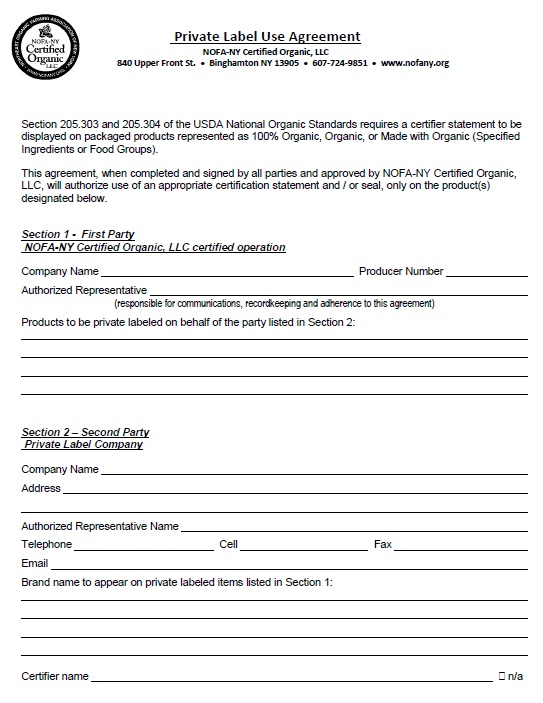
Private Label Use Agreement
Weighted towards the trademark licence — what the manufacturer may do with the buyer’s brand, and for how long.
File Type: MS Word (ZIP File)

Private Labeling Agreement
Covers packaging, artwork and labelling responsibilities in more detail than the general templates.
File Type: MS Word (ZIP File)

Private Label Agreement (Word)
Standard commercial and quality clauses in an editable Word file.
File Type: MS Word (ZIP File)

Short Private Label Agreement
The core supply and branding terms only, for a small or trial arrangement.
File Type: MS Word (ZIP File)

Private Label Agreement (Revised Format)
An alternative clause arrangement, worth comparing against the standard version before you commit.
File Type: MS Word (ZIP File)

Private Label Contract
A complete contract with signature blocks, ready to adapt and execute.
File Type: MS Word (ZIP File)
Manufacturing and Supply Agreements

Private Label Manufacturing Contract
Production-focused, with specification, quality standards and inspection rights set out in full.
File Type: MS Word (ZIP File)

Private Label Manufacturing Agreement
Covers batch production, acceptance testing and what happens to rejected goods.
File Type: MS Word (ZIP File)

Manufacturing Agreement
A general contract manufacturing agreement, usable where branding is a secondary concern.
File Type: MS Word (ZIP File)

Supply and Manufacturing Agreement
For an ongoing supply relationship, with forecasting and capacity commitments rather than one-off orders.
File Type: MS Word (ZIP File)
Intellectual Property, Tooling and Branding
Three questions decide how much control a brand actually has, and most private label agreements answer only the first.
Who owns the trademark licence terms? The buyer licenses its brand to the manufacturer solely to apply it to the agreed products. The licence should end when the agreement does, with an obligation to destroy or return unused packaging. Without that, branded stock can keep appearing after the relationship has ended.
Who owns the formulation or design? If the manufacturer developed the recipe, they usually own it, and the buyer cannot take it to a competing factory. If the buyer paid for its development, say so explicitly and assign it in writing — paying for development work does not transfer ownership by default.
Who owns the tooling? Moulds, dies and print plates are often paid for by the buyer and kept by the manufacturer. State that the buyer owns them, that they are identified and marked, and that they must be released on termination. A brand that cannot retrieve its moulds is locked in regardless of what the pricing clause says.
Artwork and packaging design should be assigned to the buyer too, including any work the manufacturer’s own designers produced.
Quality, Compliance and Product Liability
The brand on the label is usually the first defendant when a product causes harm. A consumer does not know who made it, and in many legal systems the party that presents itself as the producer is treated as the producer.
The agreement should therefore cover:
- Specification and acceptance criteria — objective, testable, and attached as a schedule
- Inspection rights — the right to inspect at the factory before shipment, not only on arrival
- Rejection — what happens to a failed batch, who pays for rework or replacement, and the timescale
- Regulatory compliance — who is responsible for the product meeting food, cosmetics, electrical or labelling rules in each market
- Indemnity — the manufacturer covering claims arising from defective manufacture
- Insurance — product liability cover at a stated minimum, with the buyer named where possible
- Recall — who decides, who runs it, and who pays
An indemnity from a small overseas factory with no assets in your jurisdiction is worth less than it reads. Insurance, inspection and holding back part of the payment are more reliable protections than a promise to indemnify.
Sourcing Across Borders
Most private label manufacturing is cross-border, which adds several terms the domestic templates omit.
Incoterms decide where risk and cost pass between the parties — EXW, FOB and CIF allocate shipping, insurance and customs very differently. Name the term and the version.
Pre-shipment inspection by a third-party agency is standard practice when sourcing from a factory you cannot visit regularly. Build it into the payment schedule so that final payment follows a passed inspection.
Payment structure — a deposit on order with the balance against inspection or shipping documents is the usual compromise between a factory that wants certainty and a buyer that wants recourse.
Governing law and arbitration. A judgment from your home court may be difficult to enforce against an overseas factory. Arbitration under a recognised set of rules is generally easier to enforce internationally, which is why cross-border supply contracts commonly use it.
Common Mistakes to Avoid
The most common mistake is no written specification. “As per sample” is not a specification once the sample has been lost or the person who approved it has left.
The second is silence on tooling ownership. The buyer pays for the mould, the factory keeps it, and the buyer discovers at the first price increase that it cannot move production.
The third is assuming the manufacturer carries product liability. The brand on the label is usually sued first, and an indemnity is only as good as the indemnifier’s assets and insurance.
The fourth is no exclusivity or non-compete clause. Without one, the factory can make the identical product for a competitor the following month.
Finally, do not leave the run-off undefined. Decide in advance what happens to finished stock, work in progress, raw materials and printed packaging when the agreement ends.
Related Supply and Agreement Templates
- Reseller agreements — for selling the finished product through partners
- Purchase agreements — including international contracts for the sale of goods
- Non-disclosure agreements — to sign before sharing a specification or formulation
- Indemnity agreements — for allocating product liability separately
- Sales representative agreements — for taking the product to market
- Wholesale price lists — for pricing the finished range
- Product quotations — for quoting buyers
- Product schedules — for listing specifications and variants
- Audit report templates — for factory and quality audits
- All agreement templates — the complete collection
Frequently Asked Questions
What is a private label agreement?
A private label agreement allows one business to have goods manufactured by another and sell them under its own brand. It covers specification, branding rights, minimum orders, quality standards, product liability and what happens when the arrangement ends.
What is the difference between private label and white label?
Private label goods are made to a buyer’s specification and are usually exclusive to that buyer. White label goods are a generic product the manufacturer already makes, rebranded by multiple resellers at the same time.
What is the difference between OEM and ODM?
Under OEM the buyer owns the design and the manufacturer builds it, so the buyer can move production elsewhere. Under ODM the manufacturer designs the product and the buyer rebrands it, which usually means the buyer cannot take the design to another factory.
Who owns the formulation in a private label arrangement?
Whoever developed it, unless the agreement says otherwise. If the buyer paid for development, the agreement must assign ownership explicitly — paying for the work does not transfer the rights by default.
Who owns the moulds and tooling?
Often disputed. The buyer frequently pays for tooling that the factory then keeps. State in the agreement that the buyer owns it, that it is identified and marked, and that it must be released on termination.
Who is liable if a private label product causes harm?
In most legal systems the party whose brand appears on the product is treated as the producer and is sued first. An indemnity from the manufacturer helps, but insurance and pre-shipment inspection are more reliable protection, especially where the factory is overseas.
Should a private label agreement be exclusive?
If the product is distinctive, yes — otherwise the factory can supply the same goods to a competitor. Exclusivity is usually traded against a minimum order commitment.
What minimum order quantity is typical?
It varies enormously by product and factory, so negotiate it rather than accepting the template’s placeholder. Record both the per-order minimum and any annual volume commitment, along with what happens if it is missed.
What happens to branded stock when the agreement ends?
Only what the agreement provides for. Set out whether the buyer must purchase remaining finished goods and packaging, how long a sell-off period runs, and the manufacturer’s obligation to destroy unused branded materials.
Are these private label agreement templates free?
Yes. Every template on this page can be downloaded and adapted free. They are provided as examples of document structure, not as legal advice.
