What you get here is a selection of professional, clean layouts that remove all the guesswork. I designed these with structured tables, plenty of space for detailed descriptions, and clearly defined blocks for account codes, debits, and credits. The margins are standard and everything fits on a single page of A4 or US Letter paper—well, I even made a compact version that prints two to a page if you want to save paper. You can also download Cash Voucher Templates and Petty Cash Voucher Templates from our website for free.
Over the years I have noticed that a lot of small business owners get hit with nasty surprises during tax season simply because they didn’t document their cash outflow. When you pay a vendor, hand out cash for office supplies, or clear an invoice, you cannot just rely on your memory. That is exactly why I put this collection of payment voucher templates together.
What is a Payment Voucher?
A payment voucher is a formal document used in business and accounting to record the details of a financial transaction, particularly payments made to suppliers, employees, or service providers.
In accounting frameworks, payment voucher serves as an aid to prevent unauthorized payments since it requires every payment made to be evidenced by a reason and documentations. Therefore, it assists in reducing omissions, and circumvents fraud, misappropriation of funds, facilitating in turn record keeping, and standard reporting procedures.
Standard Payment Voucher Format
To ensure your document holds up under scrutiny from accountants or tax auditors, it needs to follow a highly organized structure. You cannot just scribbling numbers on a blank piece of paper. Based on my experience designing these over the years, every official disbursement form must contain specific data fields to be considered a valid financial record.
I know this for sure from my own past experience—missing just one signature or reference number can make tracking an old transaction down the road an absolute nightmare.
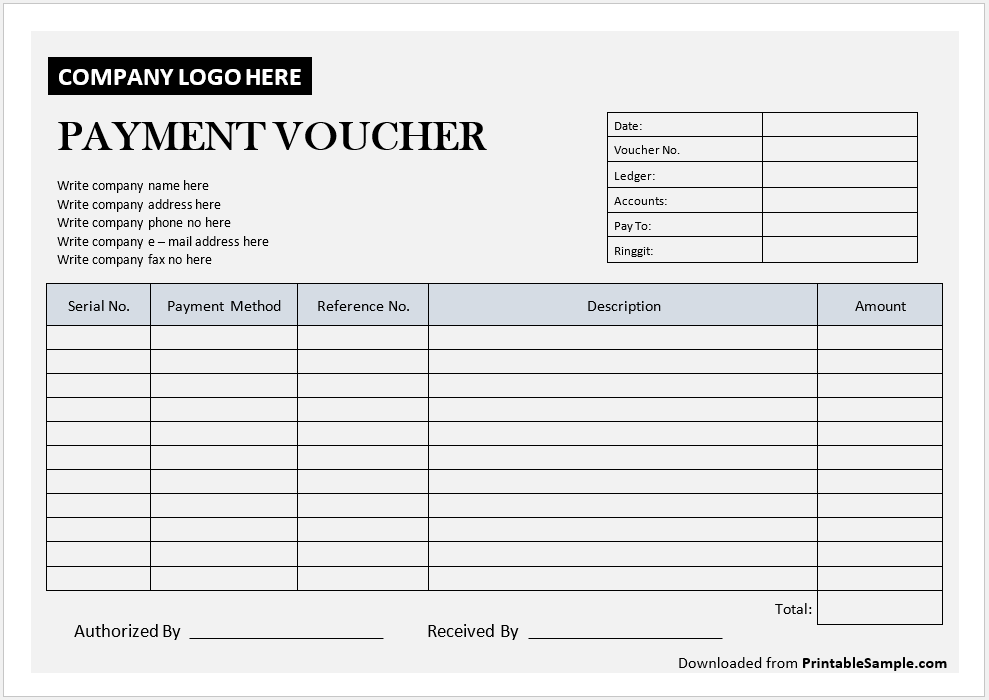
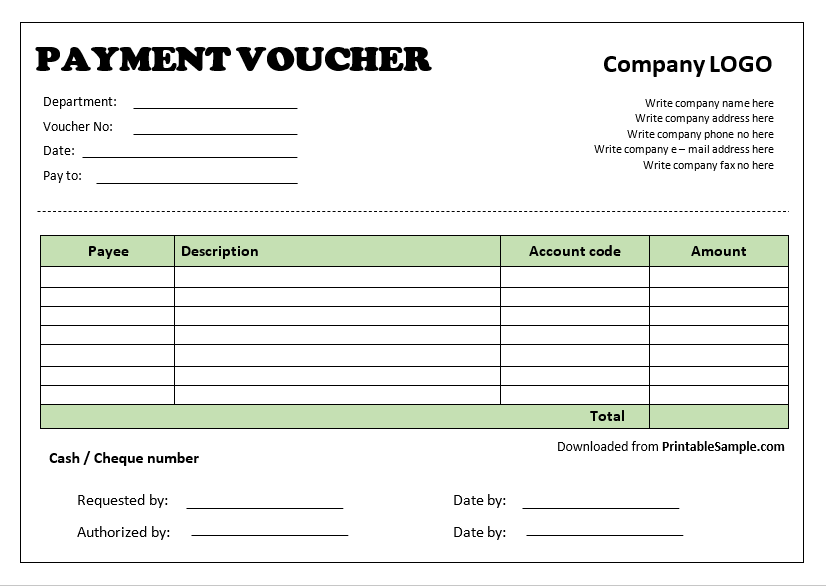
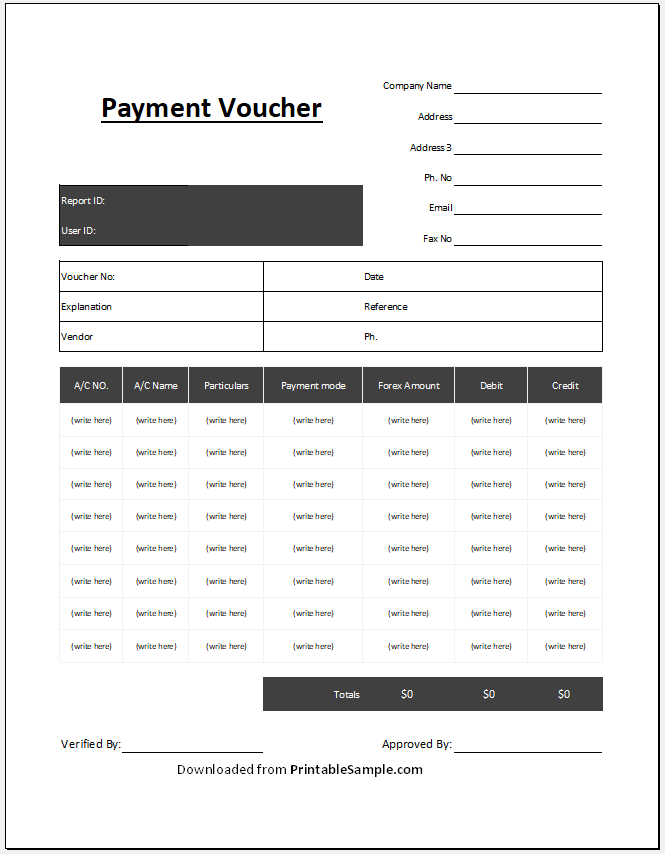
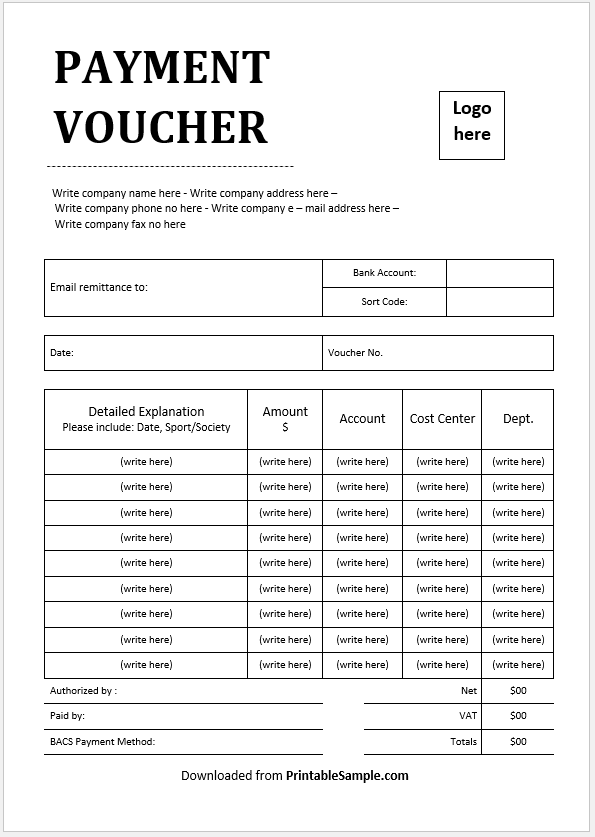
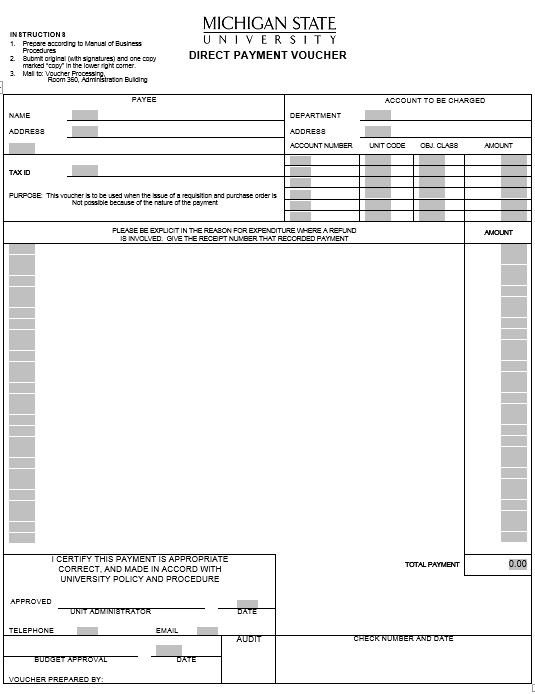
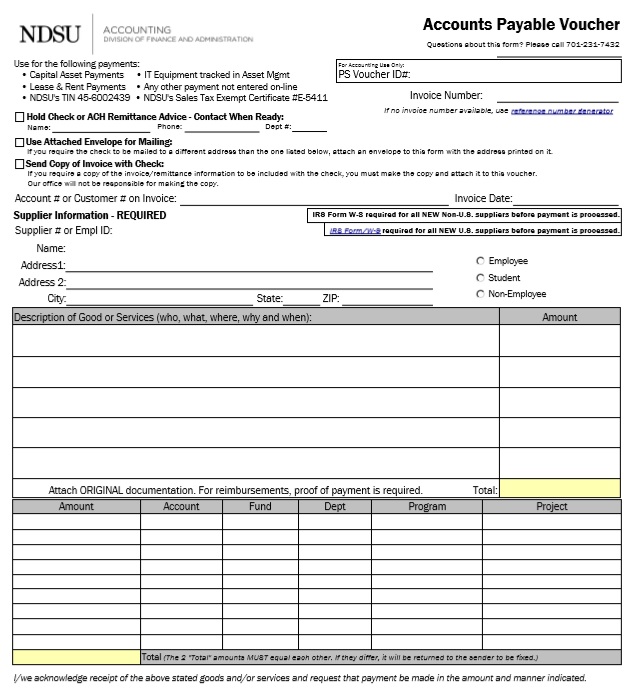
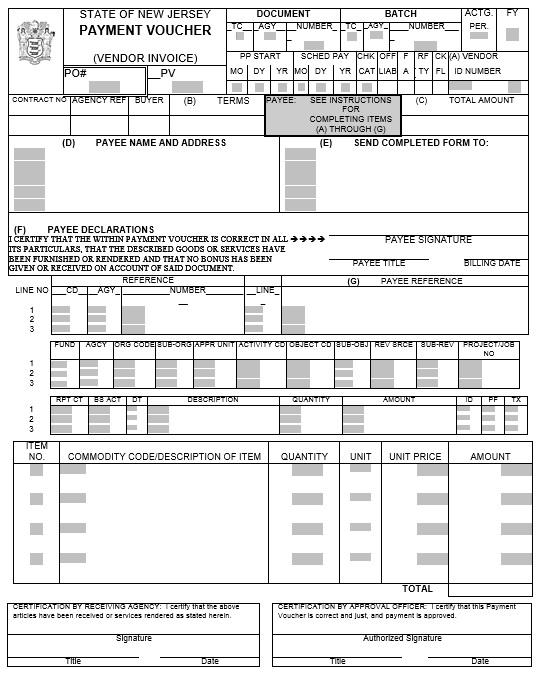
Here is the straightforward layout blueprint I use for all my templates, broken down from top to bottom:
- Company Branding Block: This sits centered right at the top. It should include your official business name, logo, registered office address, and contact details. This establishes that the voucher belongs to your specific organization.
- Voucher Header Details: Right below the company info, you need a bold title reading “PAYMENT VOUCHER.” Lined up on the right margin, include a dedicated space for the Date of Payout and a Unique Voucher Number. Keeping these sequential—like #0021, #0022, #0023—is critical for your bookkeeping trail.
- The Payee Information: A clear field stating exactly who received the money. Write out the full legal name of the individual or the vendor company, along with their contact information or invoice reference number.
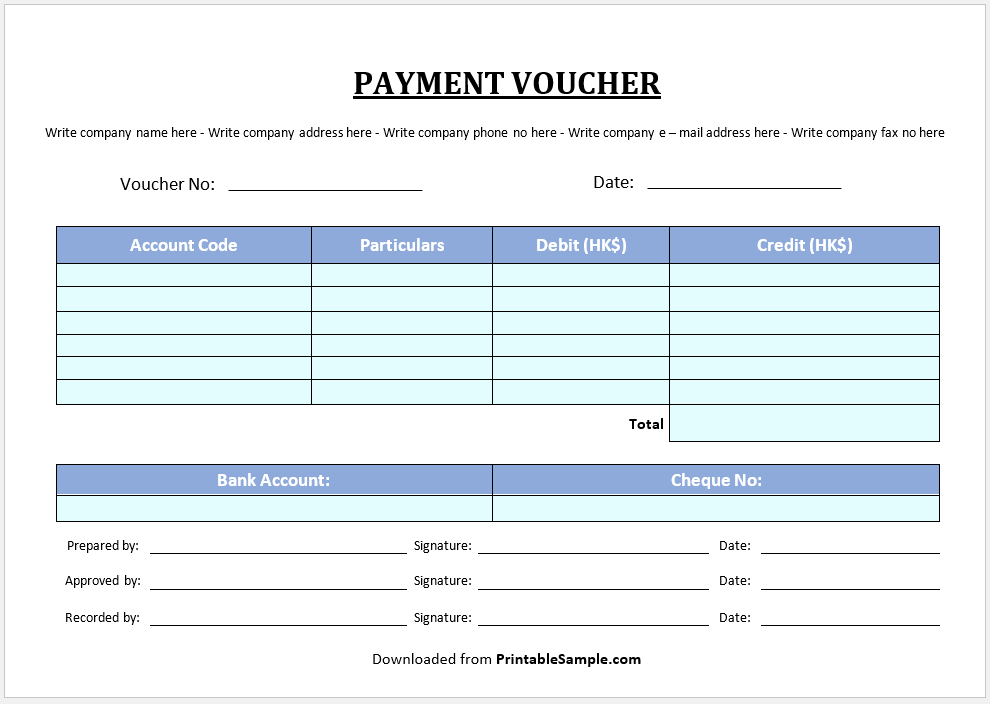
- The Main Financial Table: This is the core of the document where your numbers must line up properly. It needs three clear columns:
- Account Code/Description: What specific ledger account is this hitting (e.g., Office Supplies, Travel Expense) and what exactly was purchased?
- Debit Amount: The actual cost of the item or service.
- Credit Amount: Typically the matching total coming out of your Cash or Bank account.
- The Total Amount Row: A distinct, bolded row at the bottom of the table calculating the total payout. I always include a line to write the total amount out in words—well, right below the figures—because it prevents anyone from altering the numbers after the document is signed.
- The Authorization Signatures: This is the most critical control area. It requires a row of separate, clearly labeled signature lines:
- Prepared By: The clerk or accountant who typed up the voucher.
- Checked By: The internal auditor or supervisor who verified the math and attached receipts.
- Approved By: The business owner or manager authorizing the release of funds.
- Received By: The actual signature of the person taking the cash or check.
I have already built these exact formatting rules directly into my downloadable files. I tried to make them as print-ready as possible right out of the box, so you can just type in your business details and go. Grab the editable format below that fits your current routine, print it out, and you are all set.
Significance of Authorization Signatures and Supporting Documents
It is impossible to imagine any financial process without authorization, especially since a payment voucher has to be approved by an appropriate personnel. Normally, this means having the payment voucher signed by a responsible person; most of the time this will be the person who prepared it, the person who checked and the person who approved it and this serves to confirm that the payment is acceptable in the given situation and does not go against any policies in place. Most often, also, the voucher is submitted with a corresponding set of documents – invoice or purchase order – and receipts, which are included as justification for the payment and the entire amount claimed.
Free Payment Voucher Templates
I have made these templates completely free to download in Word, Excel, and PDF formats. I put this together so you don’t have to spend your weekend designing office forms from scratch. Grab the version that works best for your setup, fill it in, print it out, and hopefully, this saves you some time and keeps your financial records pristine.




Types of Payment Vouchers
A payment voucher falls into one among the many types depending on the purpose of transaction and the mode of payment used. Every type is prepared for recording and documenting respective situations of payments in the accounts of the enterprise. Knowing these various types of payment vouchers enables the enterprise to keep records and keep things in order on the inside, and to also ensure that the accounting rules are not flouted.
Cash Payment Vouchers
Cash payment vouchers come into play when a payment is made in cash over the counter. Such vouchers are used in cases of every day, routine expenses including small purchases such as stationery, subsidiary travel expenses, petty cash released expenses etc. The cash payment voucher provides formal references to actual cash emphasizes and enables contain receipts or vouchers for bills payment purpose. The payment of such allowance is also supported by a specimen signature of the recipient of the funds and the person authorizing the payment.
Bank Payment Vouchers
A bank payment voucher refers to the paperwork completed when making any kind of payment through the banking system i.e., via a bank transfer, check, deposit etc. Such payment voucher consists of bank details along with the payment reference and any other messages required in the transaction. Bank payment voucher is very important when dealing with huge amounts of money and payments which happen frequently such as vendors, utility bills, contractors etc. as they ensure there is an outflow cash track from the business accounts.
Expense Reimbursement Vouchers
As already mentioned, payment voucher is an attachment to the invoice, allowing both submission and payment of expense reimbursement. Vouchers are often used in payment of expenses and sometimes income received within a certain period. The voucher also states the amount spent, who the money was spent on, why, additional receipts and expense claims. This particular payment vouchers helps in controlling the management and is issued to ensure the validity of claims and reimbursements.
Salary and Advance Payment Vouchers
A salary payment voucher should be issued each time the workers’ salaries are paid, as it ensures that all authorization requirements are followed and that records of salaries paid are carefully kept. They could be accompanied by deductions and bonuses and in most cases a net salary. On the contrary, advance payments payment vouchers are prepared whenever there is payment before the performance of work or services by the supplier in question or employee concerned. This will be settled with the invoices and credits within the next invoices, which is quite essential whilst handling advance payments and prepayment mutilations.




Frequently Asked Questions
What is the difference between a payment voucher and a receipt voucher?
They are complete opposites in your bookkeeping workflow. You fill out a payment voucher whenever money is actively leaving your business—like paying a vendor, clearing a bill, or handing out petty cash. A receipt voucher is only used when cash or a bank deposit comes into your business, such as a customer paying an open invoice.
Do I still need to keep the original store receipt if I make a payment voucher?
Yes, absolutely. A payment voucher does not replace a store receipt; it acts as the cover sheet for it. I will be honest—a voucher on its own won’t satisfy a tax auditor. This might sound obvious but it actually makes a real difference: you should always staple the original invoice, cash slip, or credit card receipt directly to the back of your printed voucher as physical proof of the purchase.
Can a payment voucher be used for bank check payments?
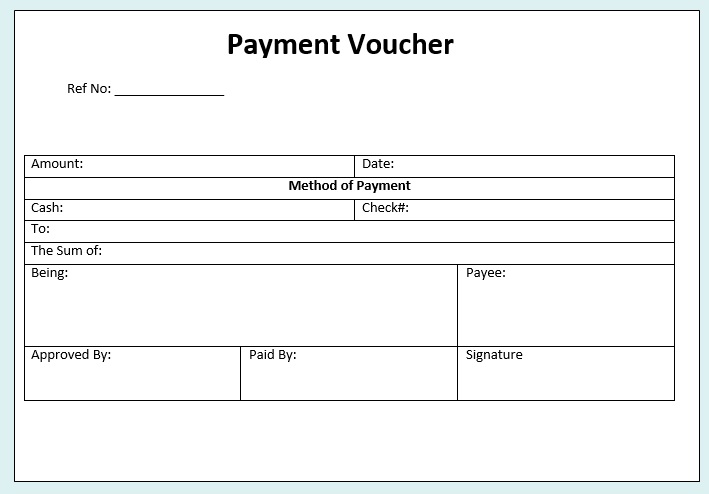
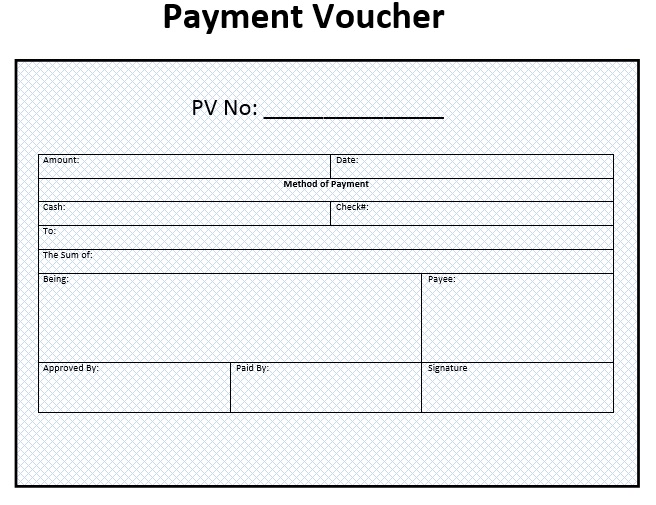
Yes, it can. While many people associate these forms strictly with cash disbursements, they work perfectly for checks and online bank transfers too. My template includes a dedicated “Payment Method” section where you can check a box for Cash, Check, or Bank Transfer, along with a line to write down the specific check number or transaction ID for easy tracking.
What should I do if a vendor refuses to sign the “Received By” line?
If you are paying via an online bank transfer or mailing a check, you won’t be able to get a physical signature on that line. That is totally fine. In those cases, leave the line blank—well, or write “Direct Deposit” across it—and staple the bank’s digital transaction receipt or the cleared check stub to the voucher instead. That counts as valid proof of delivery.
How should I organize and store my printed payment vouchers?
Over the years I have noticed that the simplest systems are always the easiest to maintain. Buy a standard lever-arch file folder and store your vouchers sequentially by their voucher number. Never file them by the vendor’s name or date. Filing them numerically makes it incredibly easy for your accountant to find voucher #0412 months down the road without flipping through the entire binder.
