I’ve been designing card game templates for a long time. Over the years I have noticed that when people look for a Hand and Foot score sheet, they are usually in the middle of planning a family game night and realized their old notebook is a total mess.
Let me be straightforward about this. Hand and Foot is a fantastic game, but the math can get out of hand fast. If you don’t have a clean layout to track your melds and book points, you spend more time arguing over the tally than actually playing the game. That is exactly why I put this collection together. I wanted to create a simple, reliable tool so you don’t have to start from scratch with a blank piece of paper.
Below, you can grab my free printable Hand and Foot score sheets. They are completely print-ready and designed to fit perfectly on standard paper.
What a Good Hand and Foot Scorecard Needs to Cover
Based on my experience designing these over the years, a proper scorecard needs to do a lot more than just give you a blank box for a total. Hand and Foot has very specific scoring rules, and a good layout should guide you through them round by round.
When you look at the templates I’ve put together, you’ll see I made sure to include dedicated spots for all the essential game metrics:
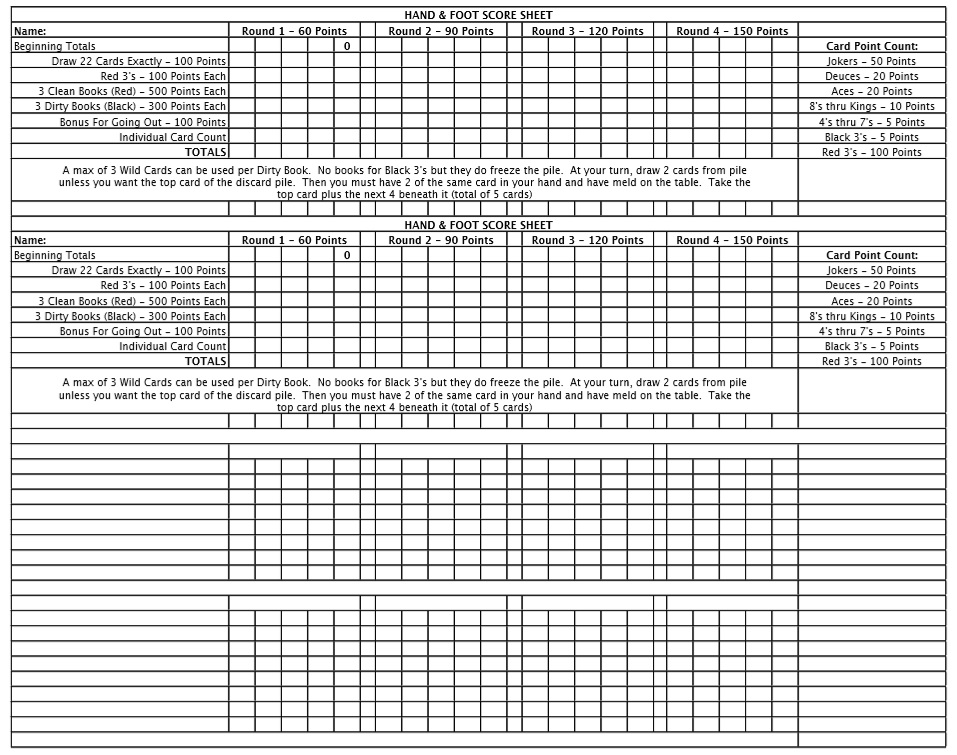
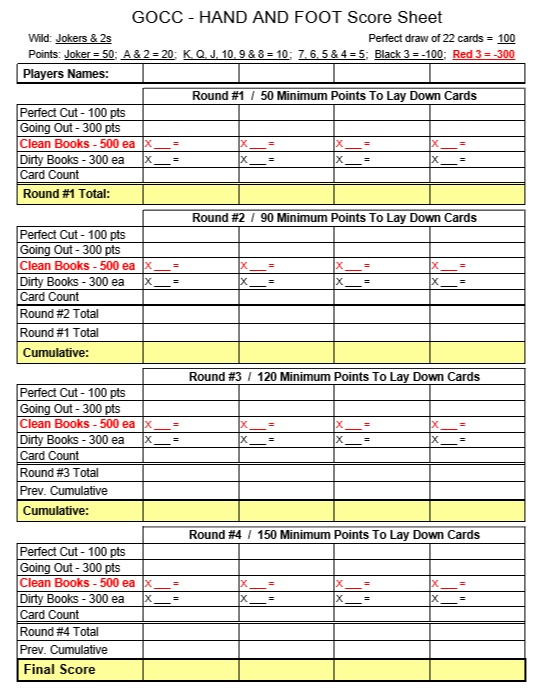
- Clean Round-by-Round Rows: Hand and Foot is traditionally played over four distinct rounds, and my layouts have clear rows for Round 1, 2, 3, and 4 so you can see the game progress naturally.
- Minimum Meld Requirements: This might sound obvious but it actually makes a real difference. I printed the minimum point requirements (60, 90, 120, and 150) right on the sheet so nobody has to keep asking what the entry score is for the current round.
- Clean and Dirty Book Tallies: Separate boxes to count your clean canastas (usually worth 500 points) and dirty canastas (worth 300 points) before you even start adding up individual card values.
- Card Point Columns: Dedicated sections to tally up the face value of the cards you laid down, as well as a spot to subtract the point values of the cards left stuck in your hand or foot.
- Running Subtotals: A clear space at the bottom of each round column to add everything up and carry the new total over to the next round without getting confused.
Why Use My Ready-Made Templates?
My over a decade of working with printable layouts tells me that usability is everything. If a template is too crowded, someone is going to write a number in the wrong column and ruin the whole score. I kept the lines crisp and made sure the grids are large enough to actually write in — which, by the way, comes in handy when you are playing with older family members who don’t want to squint at tiny print.
Now, what I personally like about this collection is the flexibility. I didn’t just make one generic layout. I put together a few different variations, including a detailed version for a massive 4-player or team game, and a simplified version that works beautifully for a quick 2-player matchup.
Every single file on this page is formatted for standard A4 and US Letter paper sizes. You can download them as a PDF if you just want to print it out and go, or grab the Word and Excel versions if you prefer to keep score on a tablet or laptop right at the card table.
They are entirely free to use. No sign-ups, no registration, and no catch. Hopefully, this saves you some time and keeps your next game night running smoothly.



How to Set Up and Use Your Score Sheet?
In all my time putting these together, one thing that keeps coming up is how easily people get confused during the post-round tally. Hand and Foot has a lot of moving parts — well, a lot of moving cards, really — and trying to count everything at once is a recipe for a headache.
Here is how I usually break it down to keep things simple:
- Write down the player or team names: Do this at the very top before the first cards are even dealt. My layouts have space for individual players or partnerships, depending on how many people you have at the table.
- Keep the minimum meld rules in view: Each round requires a higher point total just to open up your play. I’ve already printed these numbers (60, 90, 120, and 150) on the sheets, so just a quick glance will remind everyone what they need for that specific round.
- Count your books first: Once a round ends, count your completed canastas before you do anything else. Use the dedicated boxes to log your clean books and dirty books, multiply them by their point values, and write that subtotal down.
- Add up the table cards and subtract the leftovers: Count the point values of all the cards you successfully played. Then — and this is the part people hate — look at the cards left in your hand or your foot, add those up, and subtract that amount from your round score.
- Carry the running total forward: Use the row at the bottom of the column to add the current round’s score to the previous round’s total. This keeps the leaderboard clear so everyone knows exactly who is winning before the next deal.
- Declare the winner: After the fourth round, do one final calculation and write the grand total in the summary box.
And honestly, having it all laid out in front of you makes the math part move twice as fast. Grab the version that works best for your group, print it out, and you’re ready to play.
