Download these 13 free chess score sheet templates to record moves, player information, game results, and other important details during chess matches. These printable scoresheets can be useful for casual games, chess clubs, school competitions, training sessions, and tournament play.
A chess scoresheet is different from the type of scorecard used in sports where points are added throughout the game. In chess, the main purpose is to create a written record of the moves played by White and Black. That record can later be reviewed for training, analysis, tournament administration, or simply as a permanent record of the game.
If you need scorekeeping forms for other sports and competitions, browse our complete collection of free printable score sheet templates. That section includes templates for chess, tennis, football, bowling, softball, wrestling, and other activities.
What Is a Chess Score Sheet?
A chess score sheet, also called a chess scoresheet, is a form used to record the moves played during a chess game. The sheet usually has separate spaces for move numbers and for the moves made by White and Black.
Most scoresheets also provide space for the players’ names, event or tournament name, round number, board number, date, and final result. Some tournament forms may include additional fields such as player ratings, signatures, or arbiter information.
The completed scoresheet provides a move-by-move record of the game. Players can use that record afterward to replay the position, identify mistakes, study important decisions, and save memorable games.
Why Record Chess Moves?
Writing down the moves creates a permanent record that can be analyzed after the game. A player can replay the game on a board or enter the notation into chess software to study opening choices, tactical opportunities, positional decisions, and mistakes.
Scoresheets are also useful for clubs, coaches, and tournament organizers because they provide a consistent written record of what happened during a game.
For other competition formats, you may also find our bowling score sheets, tennis score sheets, and football score sheets useful.
What Information Should a Chess Score Sheet Include?
A practical chess scoresheet should make it easy to identify the game and follow the complete sequence of moves. The exact fields can vary, but several details are commonly useful.
Player Names
Record the name of the player using the White pieces and the name of the player using the Black pieces. In tournaments, player ratings, club names, school names, or identification numbers may also be included where required.
Event, Round and Board
For organized events, include the tournament or event name, round number, and board number. These details make it easier for organizers to match the scoresheet to the correct game.
Date and Location
The date is useful for any recorded game. For club matches, competitions, or memorable games, the venue or location can also be included.
Move Numbers
Each full move is normally identified by a move number. A full move consists of one move by White followed by one move by Black. The scoresheet should provide enough rows for a long game.
White and Black Move Columns
The main section usually contains one column for White’s move and another for Black’s move. Moves are written using standard chess notation rather than descriptive sentences.
Game Result
At the end of the game, record the result. Common result notation includes 1-0 for a White win, 0-1 for a Black win, and ½-½ for a draw.
Signatures Where Required
Some organized competitions require players to sign or otherwise confirm the completed scoresheet after the result has been recorded. The exact procedure depends on the event rules.
How to Write Moves on a Chess Scoresheet
Chess games are generally recorded using algebraic notation. In this system, the files of the chessboard are identified by the letters a through h, while the ranks are numbered 1 through 8.
Pieces are represented by letters: K for king, Q for queen, R for rook, B for bishop, and N for knight. Pawn moves normally use only the destination square. For example, a pawn moving to e4 is written as e4, while a knight moving to f3 is written as Nf3.
Captures, castling, promotions, checks, and checkmates have their own notation conventions. Players who are still learning notation can use a printed scoresheet during practice games to become more comfortable recording moves accurately.
Do Not Add Analysis During the Game
Symbols such as !, ?, !!, or ?! are commonly used in chess books and analysis to describe the quality of a move. They are commentary rather than part of the basic move record and should not be treated as necessary scoresheet entries during normal play.
The main objective while recording a game is to write the moves accurately and legibly so that the position can be reconstructed afterward.
13 Free Chess Score Sheet Templates
The following 13 templates come from the existing PrintableSample chess scoresheet collection. The first two were explicitly identified in the original article as Microsoft Word templates. The remaining downloads are provided as ZIP files, but their exact internal file formats were not specified in the original page content.
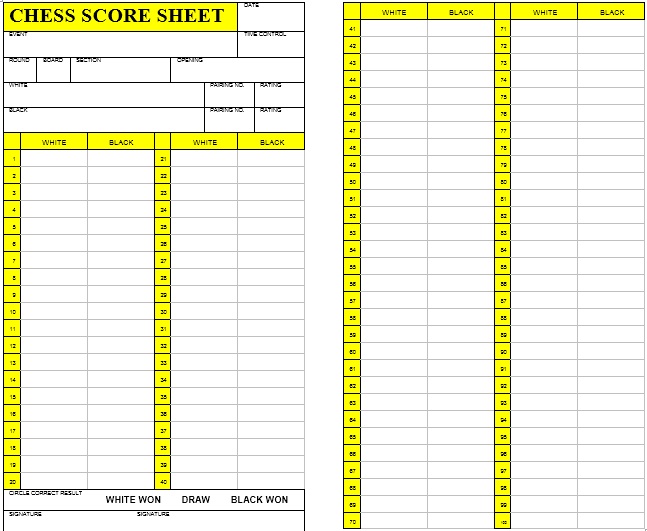


.
How to Use a Chess Score Sheet During a Game
Before play begins, fill in the identifying information at the top of the sheet. Add the names of the White and Black players, the date, and any event, round, or board information that applies.
Once the game starts, record the moves in sequence. White’s first move is written beside move number 1, followed by Black’s reply. Continue down the sheet as the game progresses.
Write clearly enough that the moves can be read later. If you make a notation mistake, correct it neatly rather than leaving the move ambiguous.
When the game ends, record the final result. In formal play, follow the procedures required by the tournament or arbiter regarding confirmation, signatures, or submission of the scoresheet.
Leave Enough Space for Long Games
Chess games can vary greatly in length. A short tactical game may end quickly, while a long endgame can continue for many moves. A practical scoresheet should therefore provide enough rows to accommodate longer games without forcing the player to write too small.
Using Chess Scoresheets for Training
A scoresheet becomes especially valuable after the game is over. Players can replay the moves and identify positions where they had better alternatives.
For students and club players, keeping old scoresheets creates a useful record of improvement over time. A coach can review several games and identify recurring problems such as opening mistakes, missed tactics, poor time management, or endgame weaknesses.
Players may also transfer recorded games into chess software or an online analysis board after the game. The written scoresheet provides the move sequence needed to reconstruct the position accurately.
Use Scoresheets in School and Club Chess
Recording moves is a useful skill for students who want to progress beyond casual play. School chess clubs can use printable scoresheets during practice games to teach algebraic notation and encourage players to review their own games afterward.
For other organized competitions, PrintableSample also provides wrestling score sheets and many other formats through the main score sheet template collection.
Paper vs. Electronic Chess Scoresheets
Traditional paper scoresheets remain useful because they are simple, inexpensive, and easy to print for clubs and competitions. Players can record moves by hand without needing a device or power source.
Electronic chess scoresheets also exist. In organized competition, however, electronic scorekeeping devices may need to satisfy specific event and federation requirements. FIDE standards, for example, include requirements for dedicated electronic scoresheets and for notation that complies with the Laws of Chess. Always follow the rules of the event you are playing in.
For casual games, either approach can work. For tournaments, use the scoresheet or approved device provided or accepted by the organizer.
Frequently Asked Questions About Chess Score Sheets
1. What is a chess score sheet?
A chess score sheet is a form used to record the moves played during a chess game along with player names, event information, and the final result.
2. Does a chess scoresheet record points?
Normally, no. Unlike sports scorecards that add points during play, a chess scoresheet records the sequence of moves. The final game result is then recorded as a win for White, a win for Black, or a draw.
3. What notation is used on a chess scoresheet?
Chess games are generally recorded using algebraic notation. This notation identifies the piece being moved and the destination square, along with additional symbols where necessary for captures, checks, castling, and other moves.
4. What does 1-0 mean on a chess scoresheet?
A result of 1-0 means White won the game. A result of 0-1 means Black won, while ½-½ indicates a draw.
5. Should I write comments such as ! and ? while recording moves?
Those symbols are generally used later during analysis to describe the quality of moves. The main purpose of the scoresheet during play is to record the moves themselves accurately.
6. Can beginners use a chess scoresheet?
Yes. In fact, using a scoresheet is a good way for beginners to practice algebraic notation and develop the habit of reviewing their games afterward.
7. Are chess scoresheets useful for school chess clubs?
Yes. They can help students learn notation, save their games, review mistakes, and build a record of their progress over time.
8. Do chess tournaments require players to record moves?
Requirements depend on the tournament format and applicable rules. Many standard competitive games require notation, while certain time controls or special circumstances may use different procedures. Players should follow the rules of the specific event.
9. Can I use an electronic chess scoresheet?
Electronic scoresheets are available, but tournament use may be subject to approval and technical requirements. In formal competition, use only a device or method permitted by the organizer and applicable chess rules.
10. Why should I keep old chess scoresheets?
Old scoresheets allow you to replay games, analyze mistakes, study openings and endgames, and track your improvement over time. They can also preserve memorable tournament or club games.
