Most training programmes are judged on whether people turned up, not on whether they learned anything. A training feedback form is the cheapest way to find out which sessions actually work, which trainers are effective, and what to change before you run the course again.
Below you will find free training feedback form templates in Word and PDF, along with the questions worth asking, how to design the rating scale, and when to collect responses.
What Is a Training Feedback Form?
A training feedback form is a short questionnaire given to participants at the end of a course, workshop or induction session. It asks what they thought of the content, the trainer, the pace and the materials, and whether they feel able to apply what they learned.
It is also called a training evaluation form, a course feedback form, or a reaction sheet. Human resources and learning teams use it to compare sessions over time; external trainers use it as evidence of quality; and auditors frequently ask to see completed forms as proof that mandatory training was delivered and reviewed.
The form is deliberately short. Anything longer than a single page tends to be completed carelessly in the last two minutes of a session.
What to Include in a Training Feedback Form
Every form needs a header section that identifies which session the responses belong to. Without it, a stack of returned forms is unusable.
- A brief introduction explaining the purpose of the form
- The date the training took place
- The location and the purpose of the training
- The trainer’s name
- The respondent’s name, or a note that responses are anonymous
- Clear instructions on how to answer each question
- The questions themselves
- A comments or suggestions box at the end
Which Questions to Ask
Eight to twelve questions is the usual range. These are the areas worth covering.
| Area | Example question | Why it earns its place |
|---|---|---|
| Content relevance | Was the material relevant to your day-to-day role? | Irrelevant content is the most common reason training fails, and the easiest to fix |
| Trainer effectiveness | Did the trainer explain the subject clearly? | Separates a weak trainer from weak material — without this you cannot tell which to change |
| Pace and duration | Was the session too fast, too slow, or about right? | A small adjustment with a disproportionate effect on comprehension |
| Materials and handouts | Were the handouts clear and worth keeping? | Identifies material people will actually refer back to |
| Venue and facilities | Was the room, equipment and timing suitable? | Logistics depress scores in ways unrelated to the teaching |
| Confidence to apply | Do you feel able to apply this in your work? | The single best predictor of whether training changes behaviour |
| Overall satisfaction | Would you recommend this session to a colleague? | One comparable number you can track across every session you run |
| Open comments | What one thing would you change? | Catches everything the fixed questions missed |
Free Training Feedback Form Templates
Each preview below links to a downloadable file. The Word versions can be edited to add your organisation’s name and your own questions. The PDF versions are ready to print for handing out at the end of a session.

Sample Training Evaluation Form
A general-purpose evaluation covering content, trainer and materials. The best starting point if you are building your own.
File Type: MS Word (ZIP File)
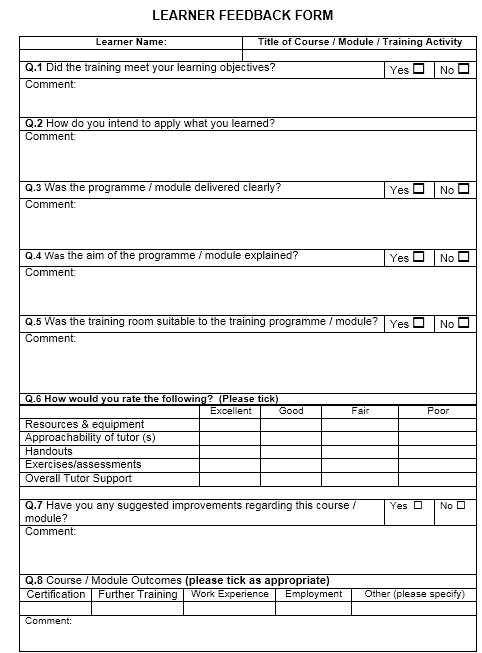
Learner Feedback Form
Written from the learner’s point of view, with more space for written comments than rating boxes.
File Type: MS Word (ZIP File)

Workshop Training Evaluation Form
A structured workshop evaluation with a clear session header, suitable for multi-session programmes.
File Type: MS Word (ZIP File)
Source: hud.gov
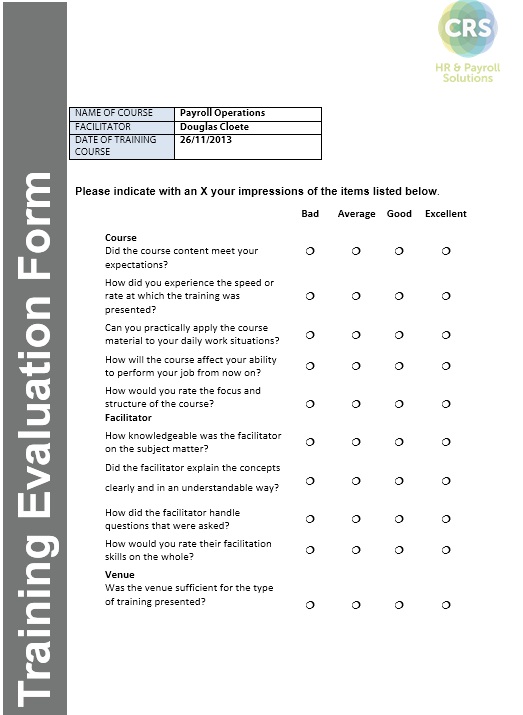
Training Evaluation Form
Numbered rating questions followed by a summary comments section. Compact enough for a single page.
File Type: MS Word (ZIP File)

Course Feedback Form
Tick-box responses on course content and delivery, quick to complete and quick to tally.
File Type: MS Word (ZIP File)

Student Training Evaluation Sheet
Worded for students rather than employees, for classroom and academic training sessions.
File Type: MS Word (ZIP File)

Training Feedback Form (PDF)
Print-ready with a rating scale and ruled comment lines. Hand out at the end of a session.
File Type: PDF (ZIP File)
Source: nhlbi.nih.gov

Training Session Feedback Form
Scoped to a single session rather than a whole course, so you can compare days within a programme.
File Type: PDF (ZIP File)

External Training Feedback Form
For courses delivered by an outside provider, with questions on the provider as well as the content.
File Type: PDF (ZIP File)
How to Write Good Feedback Questions
Sit Through the Training First
Write the questions after attending the session, not before. Generic questions produce generic answers, and the useful question is almost always the specific one about the part of the session that did not land.
Ask What People Learned, Not Only Whether They Enjoyed It
Satisfaction and learning are different things. A popular trainer can deliver a session nobody can apply. Ask both: what did you learn, and what would you change.
Offer Every Possible Answer
If a respondent cannot find an option that fits, they either guess or skip. Include “not applicable” where it makes sense, and make sure the scale covers the full range of likely opinions.
Say How to Respond
State at the top whether you want a tick in a box or a written sentence. Mixed forms with no instruction come back half-complete.
Design the Rating Scale Deliberately
A five-point scale is the usual choice, and it works well when every point is labelled rather than only the two ends. “Strongly disagree, disagree, neutral, agree, strongly agree” produces more consistent answers than a bare 1-to-5 line.
Keep the direction of the scale the same throughout the form. Reversing it halfway, even deliberately, mostly produces confused responses rather than more honest ones.
Where Feedback Fits in Training Evaluation
A feedback form measures one thing well and three things not at all. The widely used Kirkpatrick framework describes four levels of training evaluation:
- Reaction — what participants thought of the session. This is what a feedback form captures.
- Learning — what they actually know or can do now, measured by a test or practical assessment.
- Behaviour — whether they changed how they work, visible only weeks later.
- Results — whether the organisation saw an effect, such as fewer errors or faster onboarding.
Knowing this stops a common mistake. High satisfaction scores are not evidence that training worked; they are evidence that people enjoyed it. If you need proof of competence, add a short assessment and record who passed, rather than relying on the feedback form to carry weight it was never designed for.
When and How to Collect Feedback
Hand out the form before the session ends and allow five minutes to complete it. Response rates collapse once people leave the room — emailing the form afterwards typically returns a fraction of what you get in person.
For courses meant to change how people work, send a second short form thirty to sixty days later asking what they have actually used. Those answers are more useful than anything collected on the day, even though fewer people reply.
Make responses anonymous if you want honest comments about the trainer. Named forms are appropriate when you need to record individual completion for compliance, but expect softer criticism.
Record attendance separately from feedback. Keep a training attendance sheet for who was present and the feedback form for what they thought — combining them into one document makes anonymity impossible.
Common Mistakes to Avoid
The most common mistake is collecting feedback and never acting on it. If participants see the same problems in the next session, response quality drops and the exercise becomes theatre.
The second is asking too many questions. A three-page form returns worse data than a one-page form, because people stop reading and start ticking the middle column.
The third is leading questions. “How helpful was the trainer?” assumes the answer. “How would you rate the trainer?” does not.
The fourth is omitting the session details from the header. A pile of forms that does not say which course or date they relate to cannot be analysed at all.
Finally, do not use a satisfaction score as evidence of competence. They measure different things, and auditors know the difference.
Related Training and Evaluation Templates
A feedback form is one document in a training record. These formats cover the rest:
- Training attendance sheets — to record who attended each session
- Training certificates — to issue on completion
- Training sign-in sheets — for signing participants in on the day
- Teacher evaluation forms — for assessing classroom teaching rather than workplace training
- Peer evaluation forms — for colleagues assessing one another’s contribution
- Customer satisfaction surveys — the same question-design principles applied to customers
- Meeting agenda templates — for the review meeting where feedback is actually discussed
- All printable forms — the complete collection
Frequently Asked Questions
What is a training feedback form?
A training feedback form is a short questionnaire given to participants at the end of a course or workshop, asking what they thought of the content, the trainer, the pace and the materials, and whether they can apply what they learned.
What questions should a training feedback form ask?
Cover content relevance, trainer effectiveness, pace, materials, facilities, confidence to apply the learning, overall satisfaction, and one open question asking what the participant would change. Eight to twelve questions is the usual range.
How long should a training feedback form be?
One page. Longer forms are completed carelessly in the last minutes of a session, and the extra questions return worse data than the shorter form would have.
Should training feedback be anonymous?
Anonymous forms produce more honest comments about the trainer. Use named forms only where you need to evidence individual completion for compliance, and expect gentler criticism when you do.
What is the difference between a training feedback form and a training evaluation form?
In everyday use they are the same document. Strictly, feedback refers to participant reactions, while evaluation can extend to testing what was learned and whether behaviour changed afterwards.
When should training feedback be collected?
Before participants leave the room, with five minutes set aside for it. For courses intended to change working practice, send a second short form thirty to sixty days later asking what has actually been used.
What rating scale works best on a feedback form?
A five-point scale with every point labelled, such as strongly disagree through to strongly agree. Keep the direction consistent across the whole form.
Does a good feedback score mean the training worked?
No. A feedback form measures reaction, which is the first of the four Kirkpatrick levels. Proving that people learned, changed their behaviour, or improved results requires an assessment and follow-up, not a satisfaction score.
Are these training feedback form templates free?
Yes. Every template on this page can be downloaded, edited and printed free for internal training use.

Pingback: Career Interest & Aptitude Survey — Free Printable Templates
Pingback: Customer Satisfaction Survey Template — Free Word & PDF
Pingback: Career Development Survey Template - Free Word & PDF
Pingback: Standard Operating Procedure (SOP) Templates for Word