Download these 7 free construction punch list templates to record unfinished work, defects, corrections, and other items that need attention before a construction project is considered complete. The collection includes Microsoft Word, Excel, and PDF formats that can be adapted for contractors, subcontractors, project managers, inspectors, architects, and property owners.
A construction punch list provides a clear record of work that still needs to be completed or corrected near the end of a project. Instead of relying on verbal instructions or scattered notes, the project team can list each issue, assign responsibility, set a target date, and track whether the item has been corrected and verified.
A punch list is normally part of the broader project closeout process rather than a replacement for the construction contract, drawings, specifications, inspection reports, or other project records. For projects that need structured planning from the beginning, our project charter templates can help define objectives, responsibilities, milestones, and project expectations before work progresses to completion.
What Is a Construction Punch List?
A construction punch list is a list of incomplete, defective, damaged, or nonconforming items identified during an inspection of a construction project. It is commonly prepared as work approaches substantial completion so that outstanding issues can be corrected before final closeout.
The items on a punch list can range from minor cosmetic problems to incomplete installations. Examples might include damaged paint, missing hardware, unfinished trim, doors that require adjustment, incomplete electrical fixtures, cracked tiles, plumbing issues, missing labels, damaged surfaces, or work that does not match the approved plans or specifications.
The exact closeout procedure depends on the project and contract. Owners, architects, engineers, contractors, subcontractors, or other project representatives may participate in identifying and reviewing punch-list items. The contract documents should determine who is responsible for inspection, correction, verification, acceptance, and final payment.
Why Use a Punch List?
Construction projects involve many trades working at different stages, so small incomplete items can easily be overlooked. A punch list brings those remaining issues together in one organized record and makes it easier to see what still needs attention.
It can also improve accountability. When each item includes a location, description, responsible party, due date, and status, contractors and subcontractors have a clearer understanding of what needs to be corrected. Project managers can then review progress without repeatedly creating new lists.
During active construction, a construction daily log can be used alongside the punch list to record day-to-day activities, labor, site conditions, progress, and notable events. The daily log documents what happens during the project, while the punch list focuses on outstanding closeout items that require action.
What Should a Construction Punch List Include?
A useful punch list should contain enough information for another person to locate the problem, understand the required correction, and determine whether the item has been completed. Avoid descriptions such as “fix wall” or “repair door” when the exact location and problem can be stated more clearly.
Item or Reference Number
Assigning each punch-list item a unique number makes communication much easier. Team members can refer to item 12 or item 27 rather than trying to identify an issue from a long description.
Location
Record exactly where the problem is located. Depending on the project, this might include the building, floor, room number, unit, elevation, area, grid reference, or another location identifier.
Description of the Issue
Describe what is incomplete, defective, damaged, or inconsistent with the required work. A useful description might read “replace cracked floor tile beside Room 204 entrance” rather than simply “tile repair.”
Responsible Contractor or Trade
Identify the contractor, subcontractor, supplier, or trade responsible for addressing the item when responsibility has been established. This helps separate electrical, plumbing, flooring, painting, carpentry, mechanical, and other corrections.
Priority and Due Date
Not every outstanding item carries the same urgency. Safety-related or operational problems may require immediate attention, while minor cosmetic work may be scheduled differently. Where appropriate, add a target completion date or priority level.
Status and Verification
A punch list should show whether each item is open, in progress, corrected, rejected, or verified as complete. It is also useful to record the completion date and, where required, the person who inspected or accepted the corrected work.
If you need a simpler way to monitor project tasks outside the formal punch-list process, the project and team to-do list templates on PrintableSample provide layouts for assigning tasks, deadlines, responsibilities, and completion status.
7 Free Construction Punch List Templates
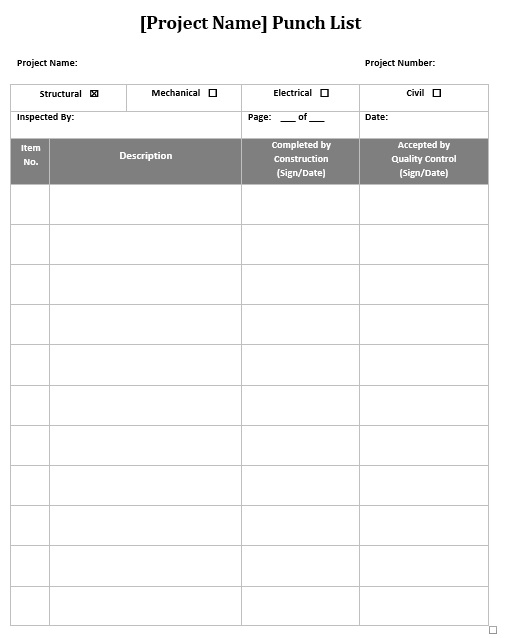
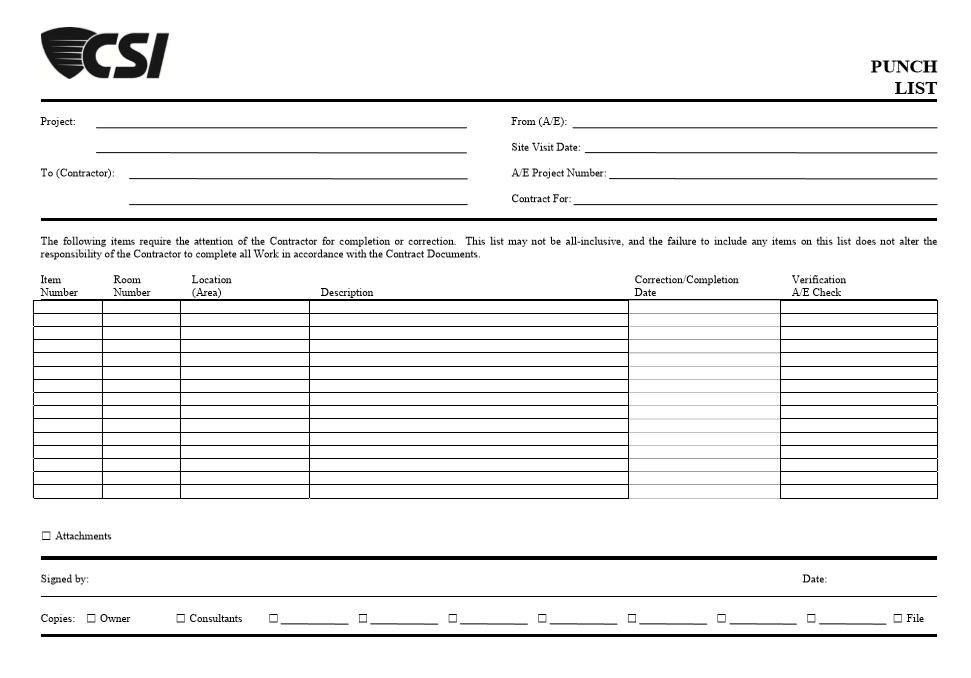
The following collection contains seven construction punch list examples in Word, Excel, and PDF formats. The first two are listed as Microsoft Word templates, the next three use Microsoft Excel, and the final two are PDF examples.
Choose a format that fits the size of your project and the way your team works. Word can be convenient for a simple printable form, while Excel is useful when you need to sort, filter, update, or track many outstanding items electronically.



5. Detailed Construction Punch List Tracker
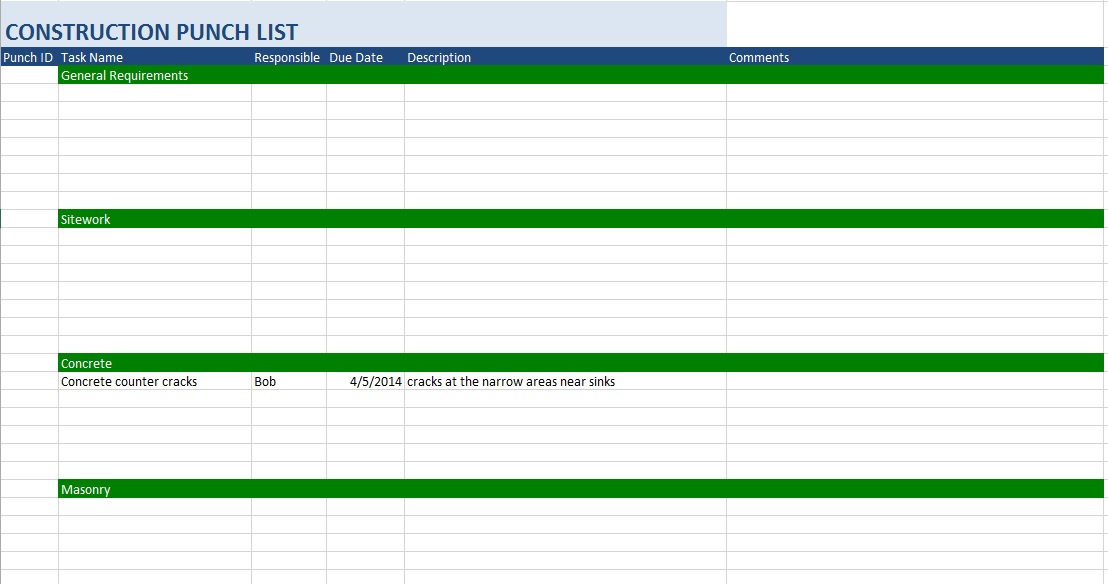
File Type: MS Excel (ZIP File)
Source: smartsheet.com

How to Create and Manage a Construction Punch List
Begin the punch-list process with a systematic inspection of the project. Walk through the work area in a logical order so that rooms, floors, units, or construction zones are not skipped. Record each issue as it is found rather than relying on memory after the inspection.
Make each entry specific enough for the responsible contractor or subcontractor to understand what needs to be done. Add photographs, drawing references, room numbers, or other supporting details when they help clarify the problem.
Next, assign each item to the appropriate responsible party and establish a realistic target date. Large punch lists are easier to manage when items can be sorted by trade, location, priority, responsible contractor, or status.
Once corrective work is reported as finished, the item may need to be reinspected. Do not mark an issue as verified merely because someone says the work is complete. Where the contract or project procedure requires inspection or approval, record the result after the correction has actually been reviewed.
Use the Punch List as a Working Document
A punch list should be updated as the project progresses. Completed items can be marked closed, rejected corrections can be reopened, and new items discovered during reinspection can be added when appropriate. Keeping one controlled version of the list helps prevent different team members from working from outdated copies.
For larger jobs, an Excel punch list can be particularly useful because rows can be sorted by contractor, location, deadline, or status. Smaller projects may only require a printed Word or PDF checklist that can be carried during a site walkthrough.
Teams managing many activities before the final inspection may also benefit from broader project and construction planner templates. Planning documents help organize the overall work, whereas a punch list concentrates specifically on deficiencies and outstanding completion items.
Keep Records of Completed Items
Keep the final punch list with relevant project documentation after closeout. Depending on the project, supporting information may include photographs, inspection records, completion dates, correspondence, test reports, warranty documents, and approval records.
A well-maintained closeout record can be useful if questions arise later about whether a particular correction was requested, who completed it, and when it was accepted.
Construction Punch List vs. Checklist
A construction checklist and a punch list may look similar, but they are normally used for different purposes. A checklist can guide routine inspections, installation steps, safety procedures, quality-control activities, or other work throughout the project. A punch list is typically focused on outstanding deficiencies or incomplete work identified as the project approaches completion.
Likewise, a punch list should not be confused with a general project schedule. Schedules and timelines track when major activities are expected to happen, while the punch list tracks specific items that still require correction or completion.
Keeping these records separate but connected makes project documentation easier to understand. The main project plan establishes what should be accomplished, daily logs document ongoing activity, inspection records identify findings, and the punch list provides a focused record of remaining closeout work.
Frequently Asked Questions About Construction Punch Lists
1. What is a construction punch list?
A construction punch list is a record of incomplete work, defects, damage, corrections, or other outstanding items that need attention before a project can be fully closed out. It helps project participants track each issue until it has been addressed and, where required, verified.
2. When is a punch list created?
A punch list is commonly prepared as a construction project approaches substantial completion, although issues may be recorded earlier as they are discovered. The timing and formal procedure should follow the applicable contract and project requirements.
3. Who prepares a construction punch list?
The parties involved vary from project to project. Owners, contractors, architects, engineers, inspectors, construction managers, and subcontractors may participate in identifying or reviewing outstanding work. The contract documents should define formal responsibilities.
4. What information should be included in a punch list?
Useful fields include an item number, location, description of the problem, responsible party, priority, target completion date, status, completion date, and verification information. Photographs or drawing references can also help explain an issue.
5. Is a punch list the same as an inspection checklist?
No. An inspection checklist is generally used to guide or document an inspection against predefined requirements. A punch list records specific deficiencies, incomplete work, or corrective items that need to be resolved.
6. Can I create a construction punch list in Excel?
Yes. Excel works particularly well for punch lists because items can be sorted, filtered, assigned, and updated electronically. Three of the templates on this page are identified as Microsoft Excel formats.
7. Should completed punch-list items be reinspected?
Where verification is required, completed items should be reviewed before they are formally closed. The appropriate person for that review depends on the contract, type of work, and project procedures.
8. What does “closed” mean on a punch list?
A closed item generally means the required correction or completion work has been performed and any necessary review or verification has been completed. Teams should define status terms consistently so everyone understands what “open,” “completed,” and “closed” mean.
9. Can new items be added after the first punch-list inspection?
Yes, additional issues may be discovered during corrective work or subsequent inspections. Whether and how they are added to the formal punch list depends on the project’s procedures and contract requirements.
10. Is a construction punch list legally required?
There is no universal rule that applies to every construction project or jurisdiction. Punch-list obligations are often established by construction contracts, project specifications, industry practices, or applicable regulations. Review the governing documents and local requirements for the particular project.
