Over the years I have noticed that a lot of people spend years working a job before realizing they absolutely hate it. It happens all the time. By then, they feel stuck because they’ve already invested 10 or 15 years into a specific industry, and starting over feels incredibly daunting.
That is exactly why I put this career path survey template together.
Based on my experience designing these over the years, the best way to avoid ending up in a dead-end job is to ask yourself the right questions early on. This isn’t a psychological test or a complicated exam—it’s just a straightforward questionnaire to help you figure out what kind of work actually suits your personality and daily preferences. I kept the layout clean and organized so you can focus on your answers without any extra clutter getting in the way.
And honestly, taking 20 minutes to fill this out now can save you a decade of frustration later.
What you get here is a print-ready document with clearly separated sections for your skills, personal interests, and work environment preferences. I’ve left plenty of room for writing out your thoughts—well, enough space for standard handwriting anyway—and the margins are set perfectly for standard A4 or US Letter paper.
Hopefully this saves you some time and helps you get some real clarity on where you want to go next. Grab the PDF or Word version below, print it out, and fill it in whenever you have a quiet moment.
My Tips for Creating a Career Path Survey
I have designed quite a lot of these over the years, and I will be honest — putting together a survey that actually works is harder than it looks. If you want to tweak my layout or build your own from scratch, here are a few practical things to keep in mind.
Keep the Instructions Simple
People need clear directions right at the top of the page. This might sound obvious but it actually makes a real difference in the quality of the answers you get. Let the person taking the survey know that there are no wrong answers here. I usually add a quick note telling them to go with their first instinct rather than overthinking what the “correct” response should be.
Treat the Questions Seriously
A career survey isn’t just a fun online quiz. People often use these results to make massive, life-altering decisions about their jobs. Because of that, you want to make sure your questions actually dig into what matters — things like work-life balance, stress tolerance, and daily tasks. In all my time putting these together, one thing that keeps coming up is that a survey is only as good as the thought you put into the questions.
Cover All Your Bases with the Options
The biggest mistake I see people make is offering limited multiple-choice options. If a reader doesn’t see an answer that fits their reality, they will just pick one randomly. That ruins the whole point of the exercise. Make sure your answer choices cover a wide range of preferences — or better yet, leave a blank line for custom notes so they can explain their thoughts in their own words.
Do a Test Run Yourself
Before you hand this out to anyone else, print out a copy and take the survey yourself. It only takes five minutes — well, ten if you really think about the answers — and it helps you catch errors immediately. You will quickly notice if a question feels confusing, if the lines aren’t lined up properly, or if you forgot to include a vital answer option.
Hopefully, these quick pointers help you adapt the layout to whatever you need.
Here is a preview of This First Sample Career Path Survey Template created using MS Word,


Here is a preview of This First Sample Career Path Survey Template in PDF Format,

Source: avma.org
Here is the download link for this Sample Career Path Survey Template,

Here is a preview of This First Sample Career Path Survey Template in PDF Format,
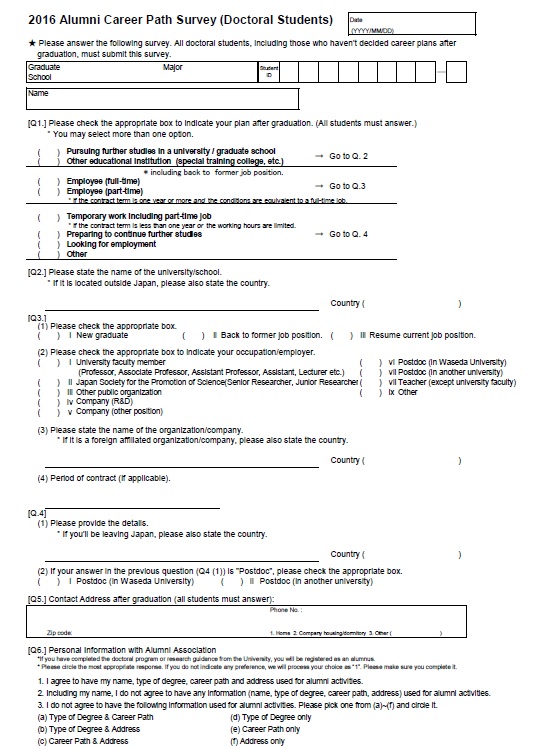
Source: gits.waseda.ac.jp
Here is the download link for this Sample Career Path Survey Template,
Here is preview of This First Sample Career Path Survey Template in PDF Format,

Source: nacacnet.org
Here is the download link for this Sample Career Path Survey Template,
Common Mistakes to Avoid
Speaking from experience — and I have designed quite a lot of these over the years — it is incredibly easy to accidentally ruin a survey layout. Even well-meaning questions can end up confusing the person filling it out if you aren’t careful.
Here are the most common traps I see people fall into when putting these together.
Making It Too Long and Exhausting
Nobody wants to sit down and fill out a massive, twenty-page questionnaire. It feels like homework. If your survey takes more than 15 or 20 minutes to complete, people are just going to rush through it to get it over with, or worse, they will just throw it in the trash. I keep my templates focused on a single page — well, two pages at the absolute most — because it keeps the momentum going.
Writing Biased or Leading Questions
This is a sneaky mistake that trips up almost everyone. A question shouldn’t push the reader toward a specific choice. For example, asking “Don’t you prefer a stable desk job over stressful fieldwork?” is already telling them how they should feel. Keep your wording completely neutral, or else the final results won’t reflect what the person actually wants.
Leaving No Room for Explanations
Multiple-choice checkboxes are great for quick reading, but they don’t capture the whole story. Real life is messy. From what I have seen, people who use this template usually want a small space to elaborate on why they chose a certain answer. If you don’t leave a few blank lines for personal thoughts, the final analysis ends up feeling a bit hollow.
Forgetting About the Presentation
This might sound like a small detail, but a cluttered page is hard to read. If your boxes are crammed together or the lines aren’t lined up properly, it creates unnecessary friction. I always make sure the margins are generous and the sections have clear breathing room, which makes a massive difference when you finally print it out on standard paper.
